


Sardina Systems completes tests of integrating FishOS and Hitachi Virtual Storage Platform (VSP), proving our platform’s capability to deliver enterprises a high-performance, scalable, fully-automated, and AI-driven cloud infrastructure solution with efficient storage. This article explores the importance of this integration, key benefits of combining Hitachi VSP and OpenStack, and an overview of the test process.
The fast pace of digitalization and growing popularity of AI drives the demand for high-performance and scalable IT infrastructure. Enterprise-grade storage systems must integrate seamlessly with Infrastructure as a Service (IaaS) platforms to meet these requirements for efficient operations.
Recently, one of our clients in Indonesia approached us with a very specific request. Our team fulfilled it in collaboration with our strategic partner, Pan Solusi. The goal was to validate the integration and compatibility of Hitachi VSP and FishOS OpenStack within a production system. Successfully implemented, it would allow the client to enjoy a fully automated OpenStack environment, delivered by FishOS and supported by the reliability and high speed of Hitachi VSP’s backend storage.
Why Hitachi VSP?
One of the reasons behind choosing Hitachi Virtual Storage Platform for the client was a set of available features for system operators, including:
- Enhanced Operational Efficiency: A large set of volume management operations, including creating, deleting volumes, along with live migration and high availability. It allows operators to efficiently manage storage resources.
- High Availability and Reliability: Includes features such as live migration and multi-attach support. This ensures minimal downtime and robust storage management, even in high-demand environments.
- Scalability with Thin Provisioning: Facilitates better resource management and cost control by enabling over-provisioning and efficient storage utilization.
- Improved Data Protection: Consistency groups and snapshot-based backups provide robust data protection and disaster recovery options, ensuring data integrity.
- Performance Optimization with QoS: Quality of Service (QoS) controls allow operators to allocate resources according to workload demands. It optimizes performance for critical applications.
Compatibility with the OpenStack Framework
The integration of Hitachi VSP with OpenStack’s Block Storage Driver provides additional functionality for efficient storage management and resilience. For example:
- Live Migration: Allows migration of volumes managed by Block Storage Driver. This supports load balancing and maintenance without interrupting active services.
- Multipath for I/O Path: Enabled for volumes managed by the Block Storage Driver, multipath configuration enhances data availability and resilience.
- High Availability for Cinder Volume Services: Allows to use the high availability cluster software to configure the cinder-volume service in a redundant active-standby setup.
- Fibre Channel Zone Manager: Streamlines storage management and reduces the need for manual configuration. For example, when a volume managed by Block Storage Driver for OpenStack is attached to a VM via Fibre Channel.
In addition, FishOS provides features like fully-automated and reliable infrastructure management. Combined, this integration allows businesses to shift their focus from infrastructure limitations to other priorities.

Potential Challenges
In theory, the Block Storage Driver for OpenStack, built on OpenStack’s Block Storage architecture (Cinder) is well-suited to incorporate Hitachi storage into IaaS.
However, achieving a balanced and efficient integration of Hitachi storage within the OpenStack framework requires overcoming certain challenges. For instance, these include the complex storage management, full compatibility with OpenStack features, and performance tuning for mission-critical workloads.
Therefore, to prevent these potential obstacles, Sardina Systems’ team had to carefully prepare for the testing process, diving deep into the documentation.
Step-by-Step Integration: How It Works
The test execution process between Hitachi and FishOS was smooth and efficient. Generally speaking, it showed that IT teams should have no trouble deploying this configuration in their environments. The process can be summarized in three main steps:
- Start the Configuration Manager REST API services. If the REST API server is installed on the Controller node, configure the OS to start REST API services before cinder-volume services.
- Obtain the storage system information, including the system ID and pool name, to prepare for the configuration.
- Configure Hitachi VSP with the Block Storage Driver for OpenStack to complete the integration.
Overall, this will help effectively manage complex workloads, scale easily, and ensure uninterrupted service.
System Configuration Overview
It is important to highlight that the system configuration supports multi-node setups, in which the Controller and Compute nodes are deployed on separate physical machines. The figure below illustrates an example of a typical configuration:
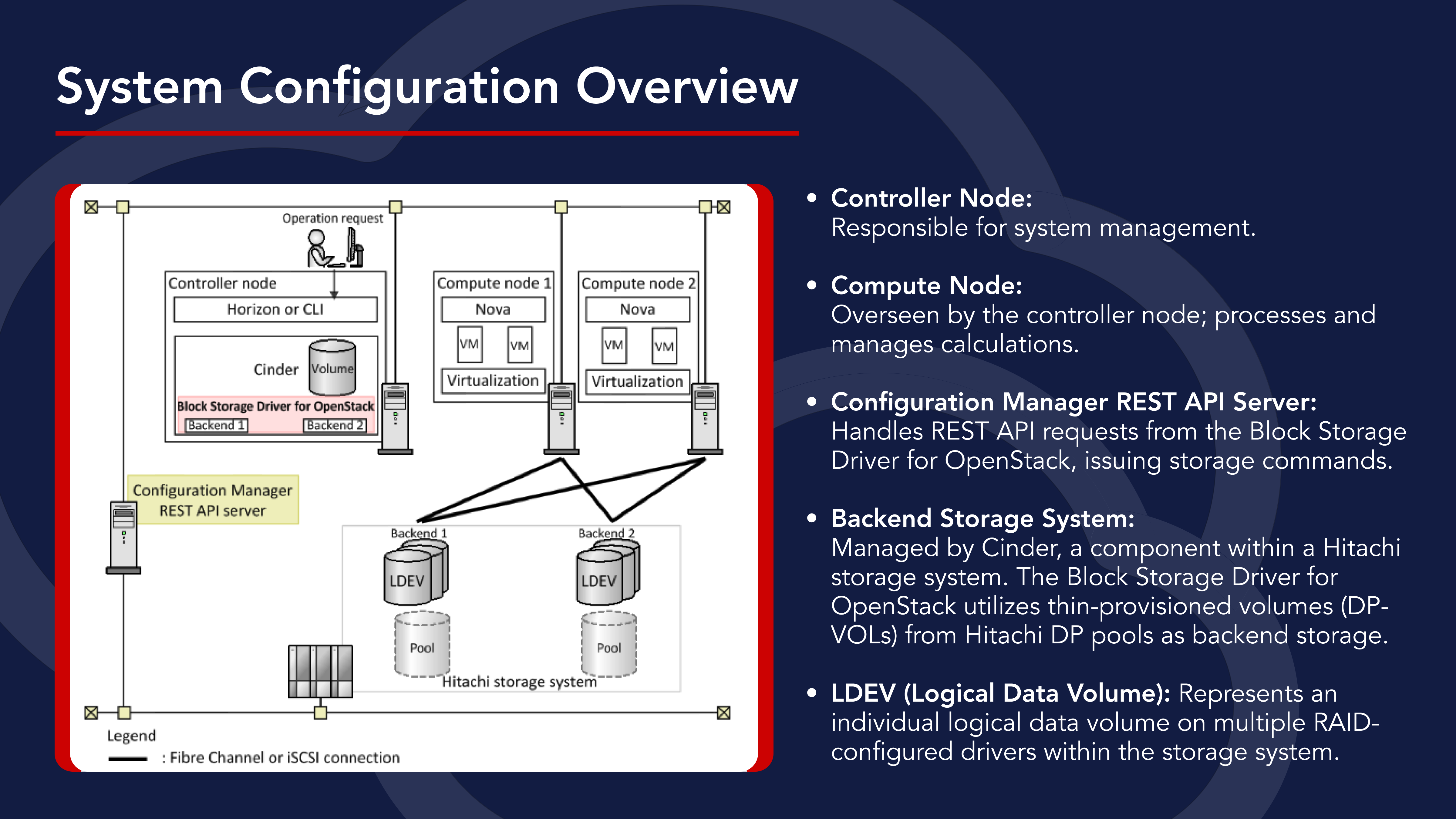
Additional notes to keep in mind:
- The Block Storage Driver (Cinder) should be installed on the Controller node.
- Configuration Manager REST API Server can be installed either independently or as part of the Hitachi Command Suite.
- The Hitachi Command Suite Configuration Manager REST API and the Hitachi Ops Center API Configuration Manager REST API are collectively referred to as the Configuration Manager REST API. The differentiation in this case can be ignored.
- In order to utilize multiple Dynamic Provisioning (DP) pools, each should be registered as a separate backend storage system.
Summary and Final Thoughts
To summarize, the integration of Hitachi VSP with OpenStack FishOS provides significant benefits for enterprises looking for efficiency, scalability, and performance in their storage and infrastructure management.
Using Hitachi VSP’s high storage efficiency with thin provisioning and dynamic pools, alongside FishOS’ fully automated, high-availability infrastructure management, enterprises can optimize resource usage. In addition, it helps reduce infrastructure costs.
Eventually, the successful integration test allows us and our partners to recommend the FishOS and Hitachi VSP configuration for their infrastructures.
Interested in optimizing your cloud infrastructure with FishOS and Hitachi VSP? Contact us today for a free personalized consultation and learn how this solution can future-proof your cloud environment.