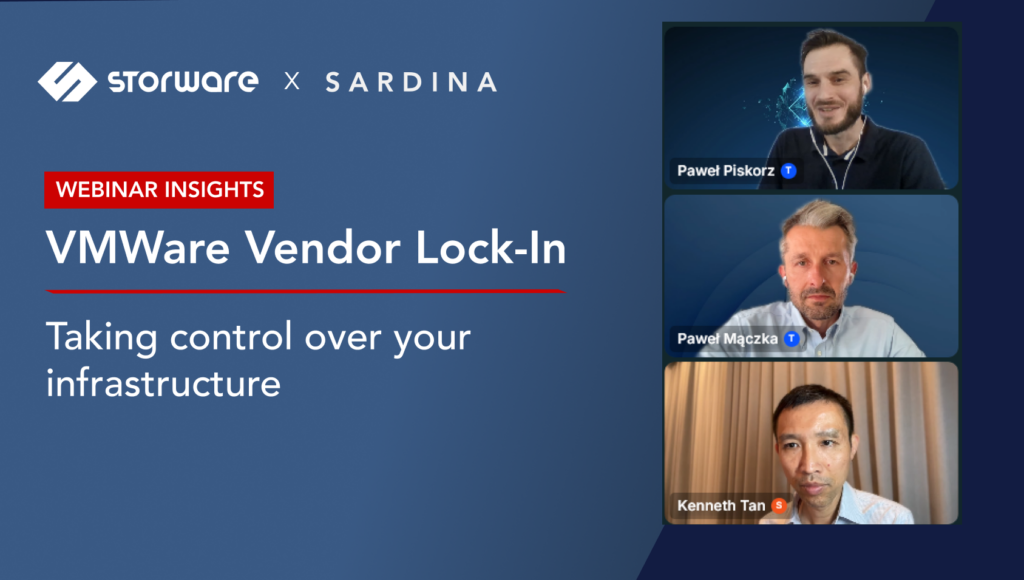

What it takes to migrate from VMware to OpenStack, and how to mitigate risks without risking your backup. An overview of the joint webinar between Sardina Systems and Storware.
Every VMware exit conversation starts with the question of why to leave, and licensing terms, rising costs, and total cost of ownership are often part of the reason.
The cost pressure may start the conversation, but it does not determine whether a migration succeeds and what you gain by moving away. The real question is harder: once you move, how much control do you actually have over your own infrastructure and over your data? Control is not only about who holds the license. It is about knowing your data is protected and recoverable throughout the migration – and after it.
That was the question under discussion in the recent joint webinar Breaking Free from Vendor Lock-In: How to Migrate from VMware to Flexible VMs. The session was hosted by Sardina Systems and Storware, our technical alliance partner.
There could not have been a more appropriate time for the webinar. According to Gartner’s Magic Quadrant for Distributed Hybrid Infrastructure, by 2029, 55% of enterprises will initiate proofs of concept for alternative distributed hybrid infrastructure products to replace their VMware-based deployments. Broadcom’s own actions, such as its restriction of VDDK downloads, further highlighted the relevance of the topic. As Paweł Mączka, CEO and Co-founder of Storware, commented: “The movement has already started, we see the huge traction.”
From VMware to OpenStack: Regaining Control
However, the story doesn’t end with the migration. In many cases, it begins there.
As we see in customer requests, organizations worldwide – from Germany to South Africa and Bangladesh – want something more than a VMware exit. They want to have infrastructure they can control and operate without being tied to a single proprietary stack.
This is where open-source-based solutions step in. Built on OpenStack, Kubernetes, and Ceph, Sardina Systems’ FishOS gives organizations a way to regain that control and a path to migrate from VMware to OpenStack.
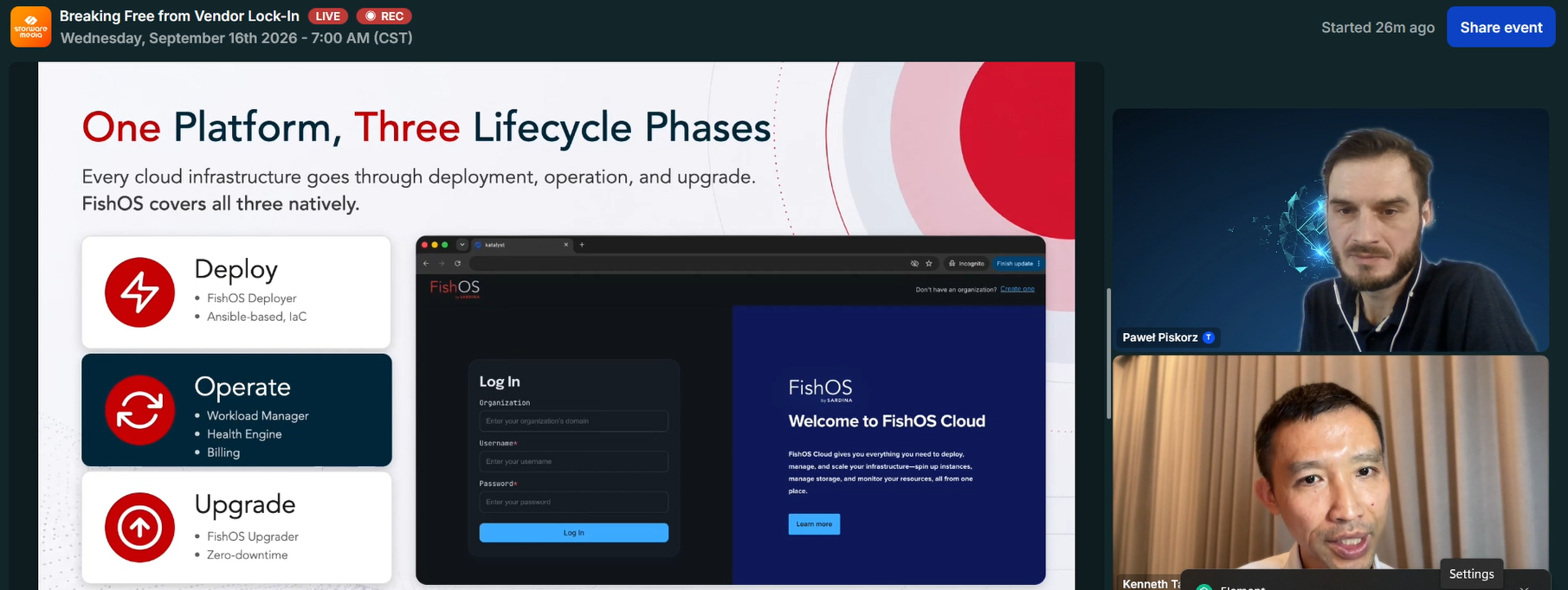
Here are three key features that make FishOS give operators greater control compared to proprietary VMware solutions:
- Core VMware functionality has a counterpart in FishOS – through direct translation or compatible functionality.
- High hardware compatibility: you can run the platform on the hardware you already have.
- The open-source foundation stays yours if your subscription ends: you can rebuild it from the upstream without losing access to your data.
In addition, FishOS provides further advantages to users who migrate from VMware to OpenStack: automated deployment and day-to-day operations, health monitoring, usage accounting and billing, and automated OpenStack release upgrades.
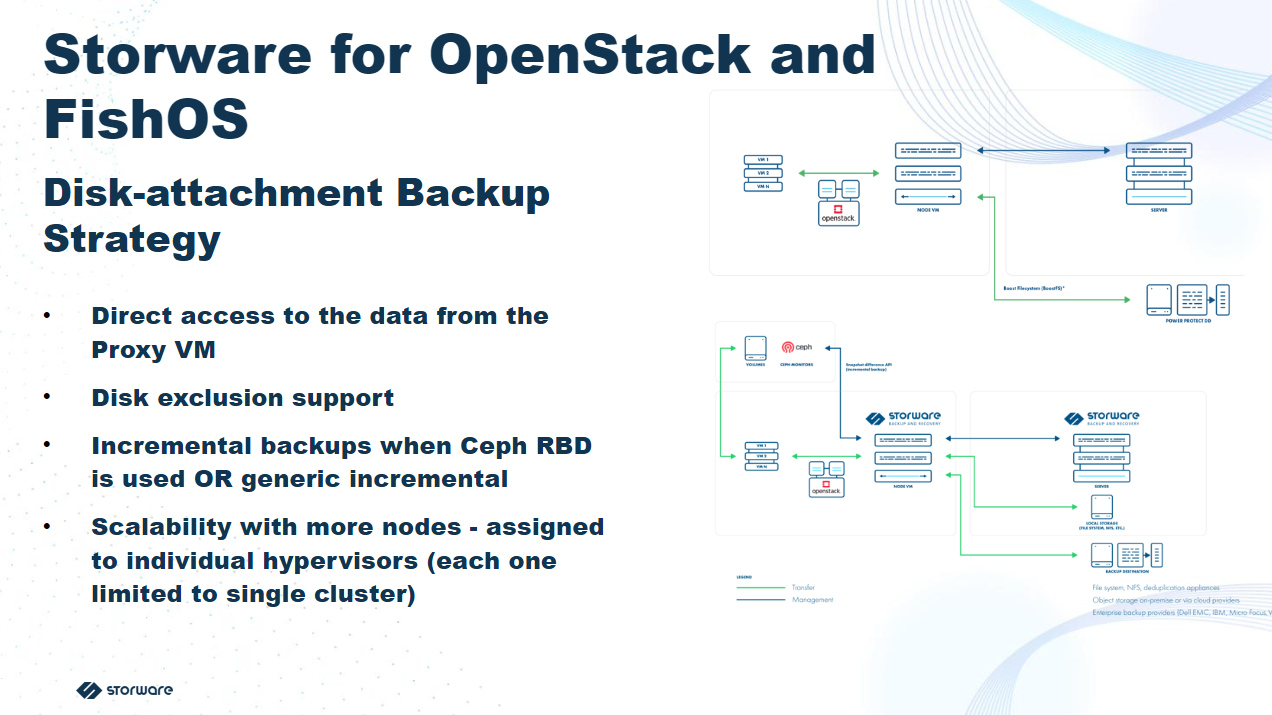
But control over the infrastructure is only half of it. The freedom is meaningful only if the migration does not replace one dependency with another: data must remain protected and recoverable, while the new environment gives organizations greater control over their infrastructure. This principle is shared by Sardina Systems and Storware and forms the foundation of our technical alliance: data protection is part of migration planning, not an afterthought. As part of this collaboration, Storware brings agentless, API-driven backup to FishOS, including Ceph-optimized data protection and multi-tenant backup-as-a-service.
VMware to FishOS Migration: Automated, VDDK-Independent
For many organizations, VMware migration remains a concern, whether because of the risks of moving an entire estate at once or because of recent restrictions on VDDK access.
To address the latter concern, Kenneth Tan explained how the FishOS Move It migration appliance provides a VDDK-independent migration workflow for customers migrating from VMware to OpenStack.
As for the recurring concern of risking workloads by moving the whole estate in one go, Kenneth Tan summarized the underlying principle:
“VMware migration does not have to be a Big Bang project. We don’t migrate what we don’t need to. We split what can be moved — what needs to be moved — versus what can be rebuilt.”
FishOS Move It migrates whole VMs from VMware while keeping the source environment available, allowing teams to validate workloads before fully transitioning them. This gives organizations the option to migrate in stages and according to their own timeline, rather than treating the migration as a single, all-at-once event. Sardina’s work with FIFGROUP, a leading Indonesian financial services provider, shows that a VMware exit does not have to mean a prolonged transformation project. A full production cluster was migrated off VMware in just four days, with workloads moved to FishOS while minimizing disruption to production operations.
VMware Replacement: How Sardina Systems and Storware Complement Each Other
Migrating a workload and protecting it are two related but different requirements. FishOS supports VMware workload migration through the FishOS Move It appliance, using a fully automated workflow.
And while FishOS Cannery provides backup and recovery of FishOS platform databases, Storware provides additional workload backup capabilities for organizations with specific protection, retention, repository, and migration requirements.
Storware’s solution provides independent backups (not just hypervisor-bound snapshots), immutability and retention controls, cross-hypervisor V2V migration, and support for external repositories ranging from tape to object storage. Independent backup copies provide an additional layer of protection if the original infrastructure becomes unavailable. As Paweł Piskorz, Pre-Sales Engineer at Storware, described: “Imagine if snapshots stay on the hypervisor. In case of a failure, if you lose the infrastructure, you will lose the snapshot.”
This is why backup planning should be considered alongside migration planning.
The Question to Ask Before Replacing VMware
The question worth asking before any VMware exit isn’t “What should replace VMware?” As Kenneth Tan put it, there are several key questions:
- Which components of the platform are proprietary and which are open source?
- Who can operate and upgrade the platform?
- Which services are actually required from the vendor?
- What happens to the system when the license ends?
- What happens to the organization’s data before, during, and after migration?
The webinar showed how Sardina Systems addresses these questions through FishOS and how Storware complements this approach with independent backup and data protection capabilities.
Ultimately, a VMware exit is about more than choosing a replacement. It is about deciding what organizations want their infrastructure to look like after the migration – who can operate it, how workloads can be moved, and how data remains protected and recoverable. These choices shape the level of control organizations have once the migration is complete.
Access the on-demand webinar here.