



As OpenStack marks 15 years this year and joins the Linux Foundation under the OpenInfra umbrella, the platform has never been more mature or trusted. With a global network of collaborators, over 40 million cores in production, and more than 300 public cloud data centers worldwide, OpenStack has firmly established itself as a cornerstone of private cloud infrastructure.
Still, despite its evolution, many enterprises still approach private cloud deployments with hesitation and often fall into avoidable traps and common mistakes. At Sardina Systems, our technical team and partners have seen firsthand what can go wrong.
Below, we share the seven most common mistakes enterprises make when adopting OpenStack and how to avoid them from day one.
1. Fearing OpenStack’s Complexity and Open Source Risks
Many organizations hesitate to adopt OpenStack due to its intricate, multi-component architecture and the perception that open source means limited support. This fear often slows down or derails deployments.
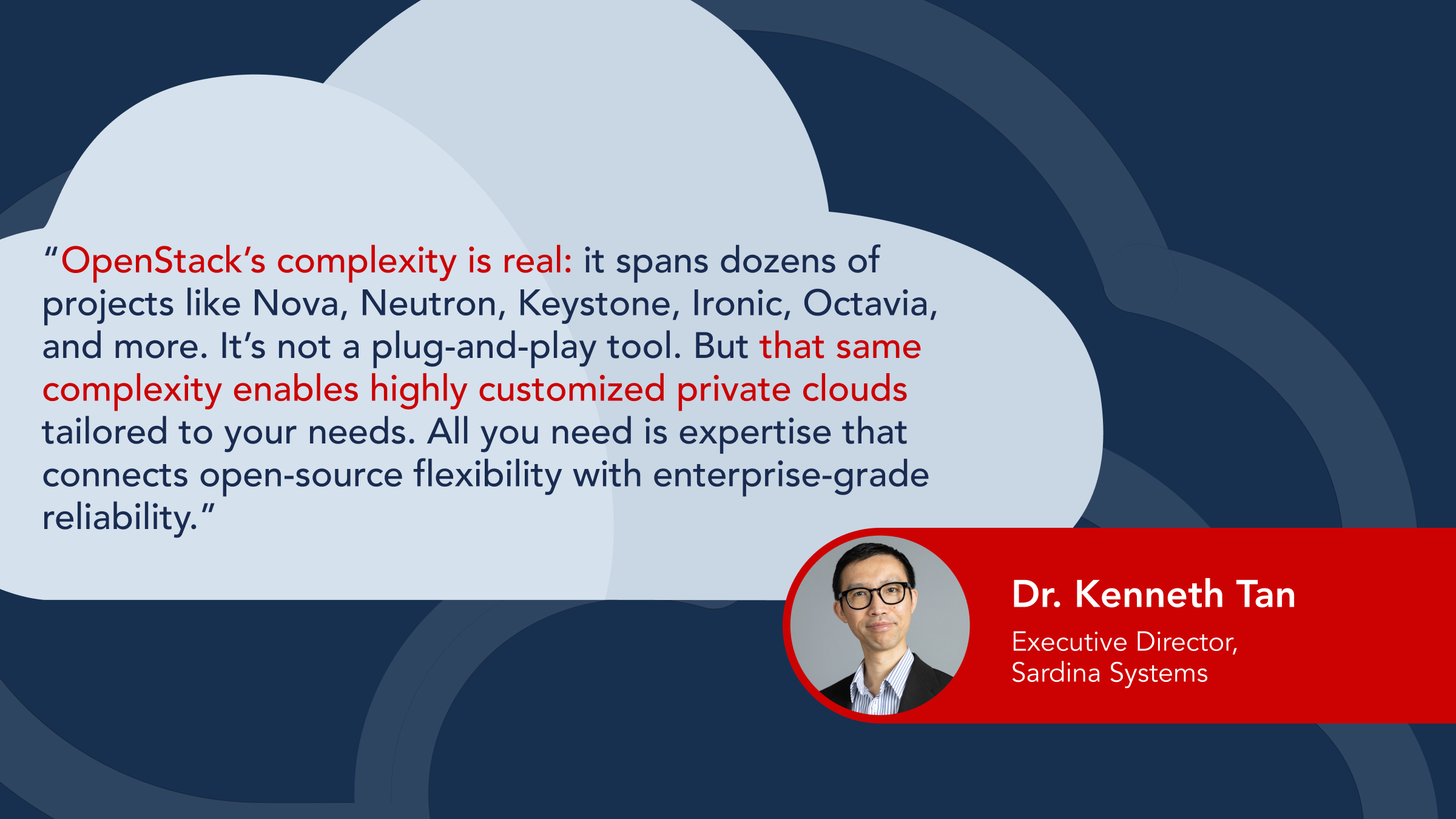
How to avoid it: Build internal expertise or work with a vendor that offers deep OpenStack knowledge, white-glove onboarding, and long-term support. Having an in-house team or a trusted partner who can guide you through architecture choices and operational setup makes all the difference.
2. Lack of In-House Expertise in Cloud-Native Tools
Outsourcing to an OpenStack vendor doesn’t mean you can operate on autopilot. Successful deployments require someone on the customer side who understands the existing infrastructure, can validate technical decisions, and coordinate with the vendor’s engineers in real time.
OpenStack environments often need decisions on networking models, storage backends, identity integration, and hardware specifics. Without internal ownership, these decisions get delayed (or made blindly).
In many cases, the absence of such a role also results in a lack of onboarding commitment: feedback is slow, priorities are unclear, and internal blockers accumulate. This not only delays rollout but also erodes the value of vendor support.
How to avoid it: Assign a technically capable engineer to act as the internal point of contact. They don’t need to be OpenStack experts, but they should be able to communicate requirements and maintain context throughout the rollout.
3. Misalignment Between Business and IT Teams
Strategic decisions by business leaders are often made without input from IT, or vice versa. When their priorities are misaligned from the start, it can lead to unrealistic expectations, under-resourced deployments, and costly delays that only become visible when it’s already too late: after procurement or during post-launch operations.
Our partners at PT. Datacomm Diangraha, a leading IT service provider in Indonesia, emphasize the importance of bridging this gap early on by involving cross-functional perspectives:
“Technical and non-technical stakeholders often have different mindsets. While technical teams focus on stability, performance, and security, business teams are more concerned with revenue, cost savings, and customer experience. To bridge this gap, we involve people who understand both sides and establish KPIs for both business and technical success to ensure balanced and aligned execution”. –
Nizar Bawazir, Cloud Technical Lead at Datacomm.
How to avoid it: Align your cloud strategy across both business and IT from day one. Involve stakeholders with dual perspectives, and establish shared KPIs that tie technical progress to business outcomes. Regular check-ins between technical leads and executive stakeholders help avoid costly misunderstandings.
4. Inadequate Capacity Planning and Lack of Integration Strategy
A common pitfall in OpenStack deployments is underestimating how much compute, storage, and network capacity your workloads truly require. Undersized infrastructure leads to performance bottlenecks, instability, and expensive mid-deployment adjustments.
Another frequent misstep is treating software and hardware planning as separate tracks. Many teams choose hardware without verifying whether it’s fully compatible with the OpenStack components they intend to use. This lack of integration strategy results in delays, driver issues, and unpredictable behavior.
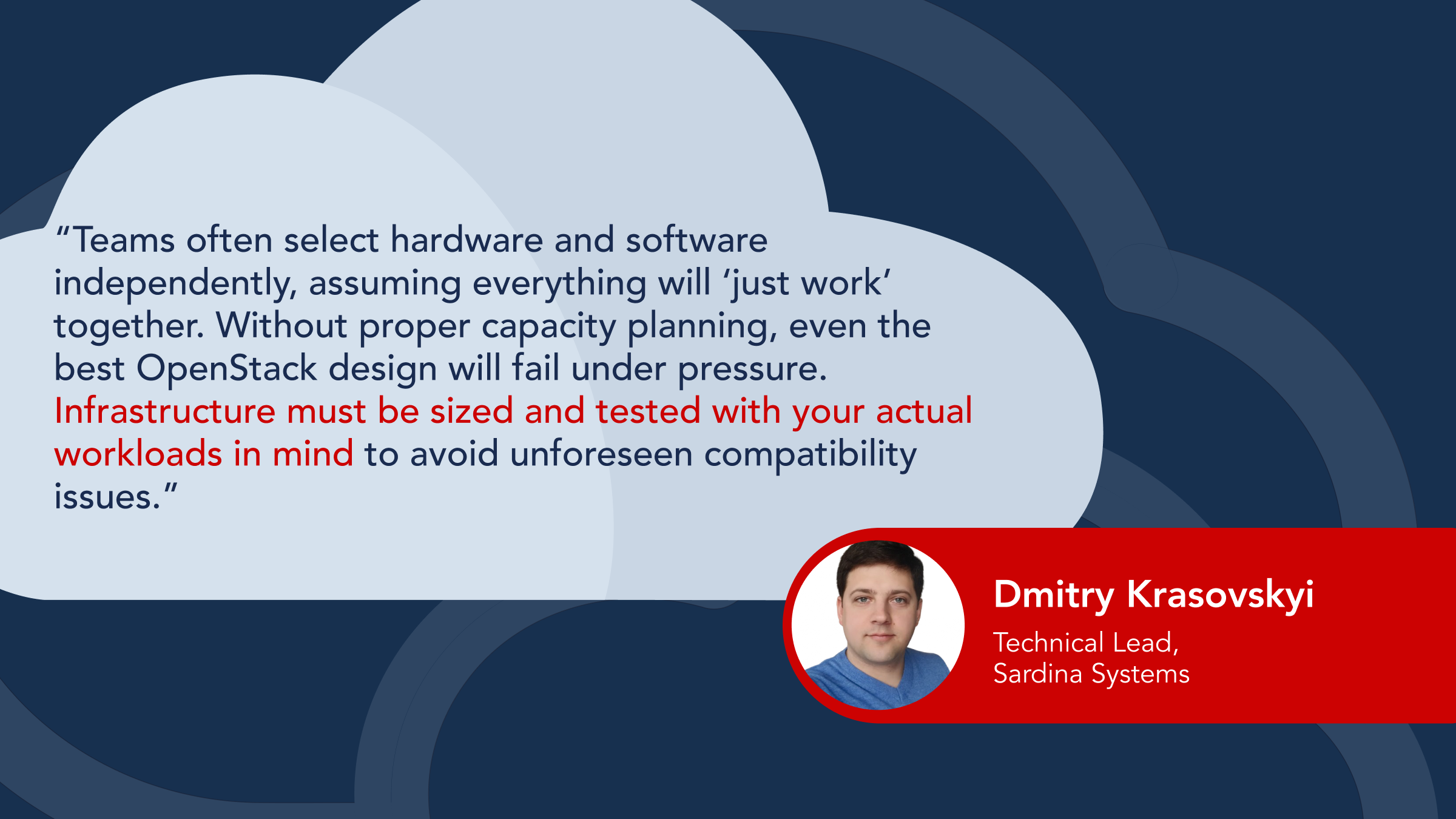
Our partners at On Demand Systems, a Singapore-based provider of HPC and AI infrastructure solutions, emphasize that inadequate workload profiling is one of the most overlooked causes of misalignment between infrastructure design and actual usage, especially for compute-intensive or high-throughput environments.
“Enterprises often underestimate IOPS requirements, metadata-heavy operations, east-west traffic, and the impact of high availability on both compute and storage capacity. These oversights lead to resource mismatches that compromise performance. It’s essential to start with detailed workload profiling, focusing on concurrency, latency, and data movement, combined with PoC simulations. Using modular storage options like FishOS Ceph or On Demand PFS supports growth and performance from day one.” –
Rakesh Sabharwal, Founder & CEO of On Demand Systems.
How to avoid it: Start with a detailed analysis of your application workloads. Plan infrastructure sizing based on realistic compute, storage IOPS, and network throughput needs. Choose a vendor who can validate your hardware stack with the specific OpenStack services you’ll deploy before going live.

5. Neglecting Backup, DR, and Security Planning
In the rush to get a private cloud up and running, it’s easy to overlook critical foundations like backup, disaster recovery (DR), and security. Many teams assume these protections are built into the platform by default, but with OpenStack, that’s rarely the case. The flexibility it offers also means you’re responsible for making sure your data and workloads are protected.
“Native OpenStack tools like Freezer can help, but they often need to be customized and integrated into broader processes. We have seen companies only start thinking about these things after their cloud is already live and vulnerable.” –
Dmitry Krasovskyi, Technical Lead at Sardina Systems.
How to avoid it: Treat backup, DR, and security as core parts of your deployment plan, not extras. Ask your vendor what is included, what you need to add, and how to integrate third-party tools where needed. Ensure security baselines are aligned with your industry’s regulatory requirements from day one.
6. Trying to Fit Cloud into Legacy Architecture
One of the most common issues we see is underestimating how different cloud architecture is from traditional IT setups. Teams often try to drop OpenStack into environments built around monolithic apps, static networking, or tightly bound storage systems. This can lead to fragile integrations, performance bottlenecks, and long-term technical debt.
How to avoid it: Use your move to OpenStack as a chance to rethink and modernize. Audit your existing architecture, and be prepared to retire or decouple components that don’t fit cloud-native principles. A good vendor will help you make the call on what can be adapted and what needs to be left behind.
7. Skipping Lifecycle and Maintenance Planning
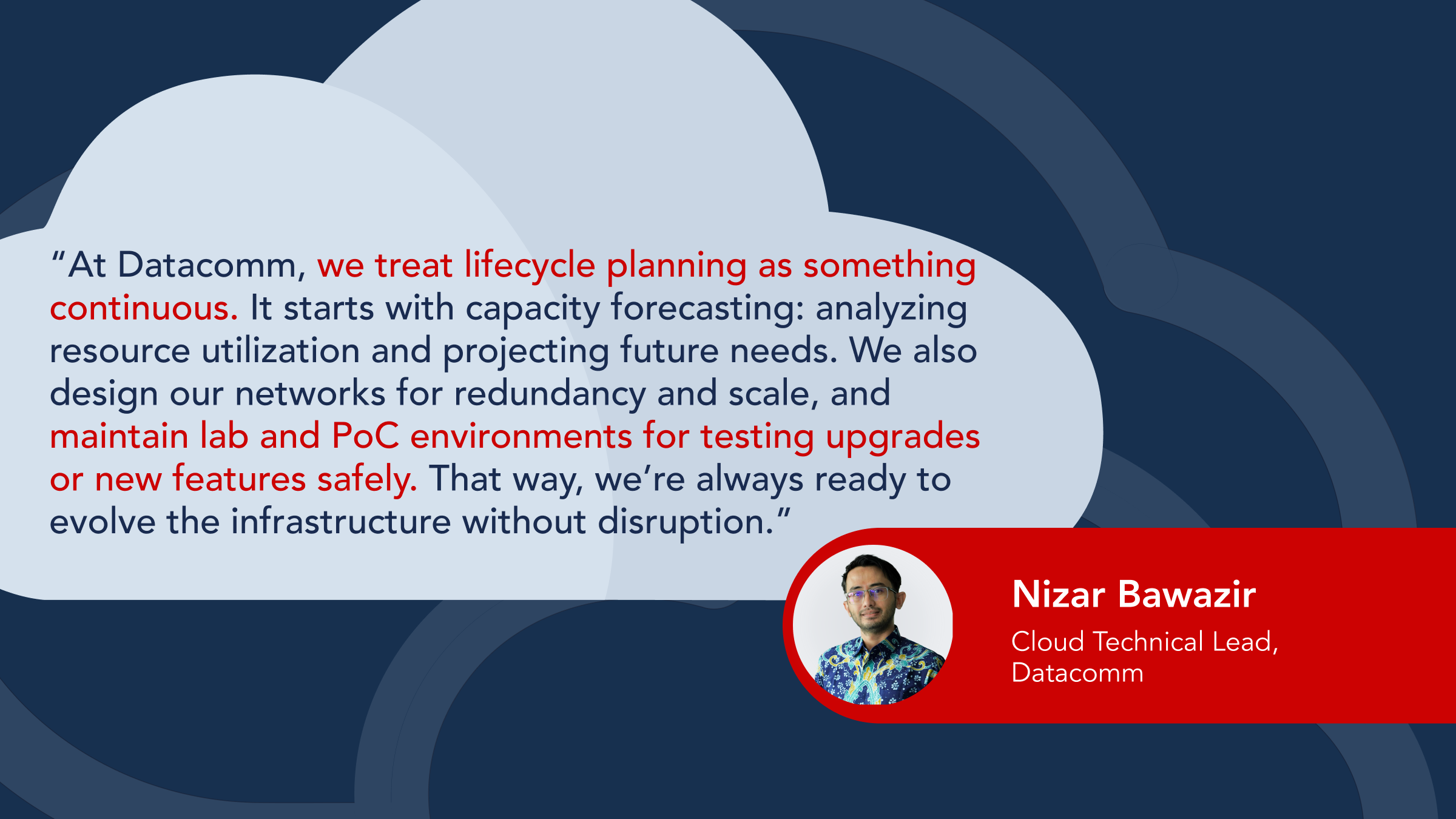
It’s easy to think of cloud deployment as the finish line. But in reality, it’s just the beginning. Teams that don’t plan for ongoing maintenance often find themselves scrambling later: delays in necessary updates, missed hardware replacement cycles, and the tendency to “wait until something breaks” before acting. Over time, this leads to degraded performance, increased risk, and higher long-term costs.
Our partners at Datacomm, a leading IT service provider in Indonesia, highlight the value of thinking ahead and building infrastructure with the future in mind.
How to avoid it: Include lifecycle planning as part of the initial deployment design. Make sure hardware refresh cycles, software updates, and scaling needs are built into the roadmap. Work with a vendor who offers ongoing support and upgrade planning, not just initial deployment.
Sardina Systems’ FishOS platform delivers a highly efficient, scalable OpenStack, Kubernetes, and Ceph-based private cloud designed to grow with your business. We offer technical consultation and a qualified PoC free of charge, and every license includes full support at no extra cost.
Ready to avoid these 7 pitfalls in your own deployment? Contact us for a free consultation: we’ll help you get your private cloud right from the start.