


This case study explores the strategic partnership between Sardina Systems and VMAccel – global AI Infrastructure and AI Data Center. It highlights how their efforts with the accelerated cloud have fostered innovation and technological advancement across multiple sectors.
Since 2021, Sardina Systems and VMAccel have been collaborating to provide robust computing power to a range of industries, including artificial intelligence (AI), machine learning, genomics, and finance. This partnership utilizes the maximum potential of a FishOS-managed system, comprising 19 compute nodes equipped with both GPU and FPGA technologies. Among VMAccel’s clients are notable brands such as Yale University, Hedgehog, Aleo, and many others.
Throughout the cooperation, FishOS has maintained uninterrupted operations, demonstrating its efficiency and reliability.
About the Case Study Participants
VMAccel is a data center specializing in AI applications. Their extensive partner network fosters collaboration and innovation to create new products. In addition, VMAccel stands out for its infrastructure, which utilizes immersion liquid cooling technology. This innovative approach involves submerging server components directly into a non-conductive liquid, greatly enhancing thermal management and energy efficiency.
The method allows VMAccel AI Data Center to maintain optimal hardware performance even under the intense computational demands of AI and machine learning workloads. It also reduces environmental impact and lowers operational costs, making it a cornerstone aspect of VMAccel’s infrastructure.
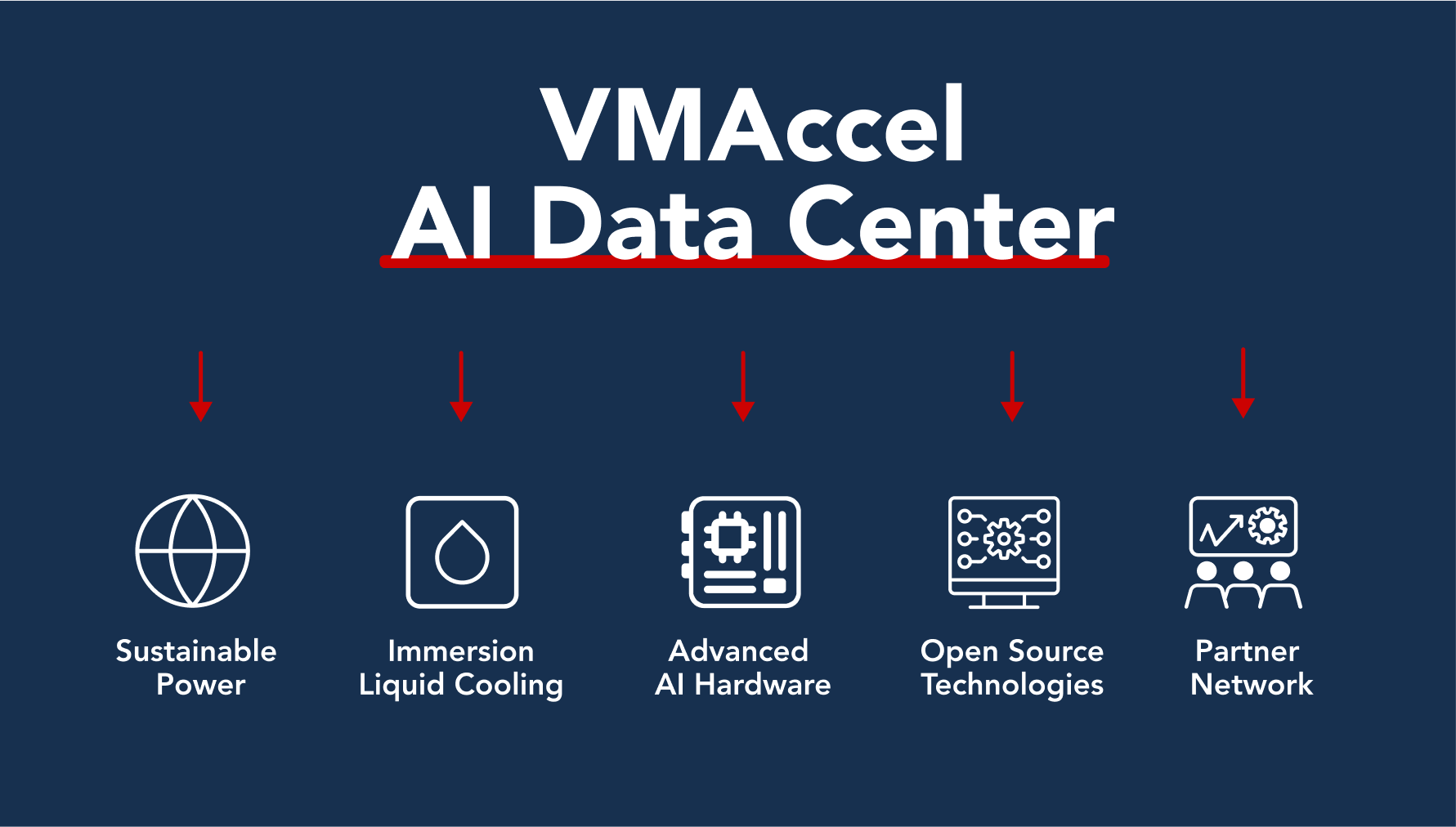
VMAccel features
Through collaboration with multiple partners, VMAccel is continuously developing new services for AI workloads. Currently, they are working on a micro data center to bring AI tools and advanced computing capabilities to the edge.
“Looking at the changing landscape for business, one only has to look at the advent of generative AI to realize that innovation and opportunity are not going to be found in the realm of today’s public clouds.
In times of rapid innovation, companies must bring their data close to them and focus on finding opportunities in existing operations to expand and grow in their market.”
Matt Fields, CEO of VMAccel AI Data Center
FishOS, Sardina Systems’ smart cloud management platform enables organizations to benefit from open source software without incurring additional costs. This intelligent infrastructure management software optimizes the deployment, operation, and performance of large-scale environments.
It provides a comprehensive suite of management tools that streamline orchestration, automation, and optimization of cloud resources. Notably, FishOS seamlessly adapts to growing needs, making it an ideal solution for businesses looking to use the full potential of open source solutions.
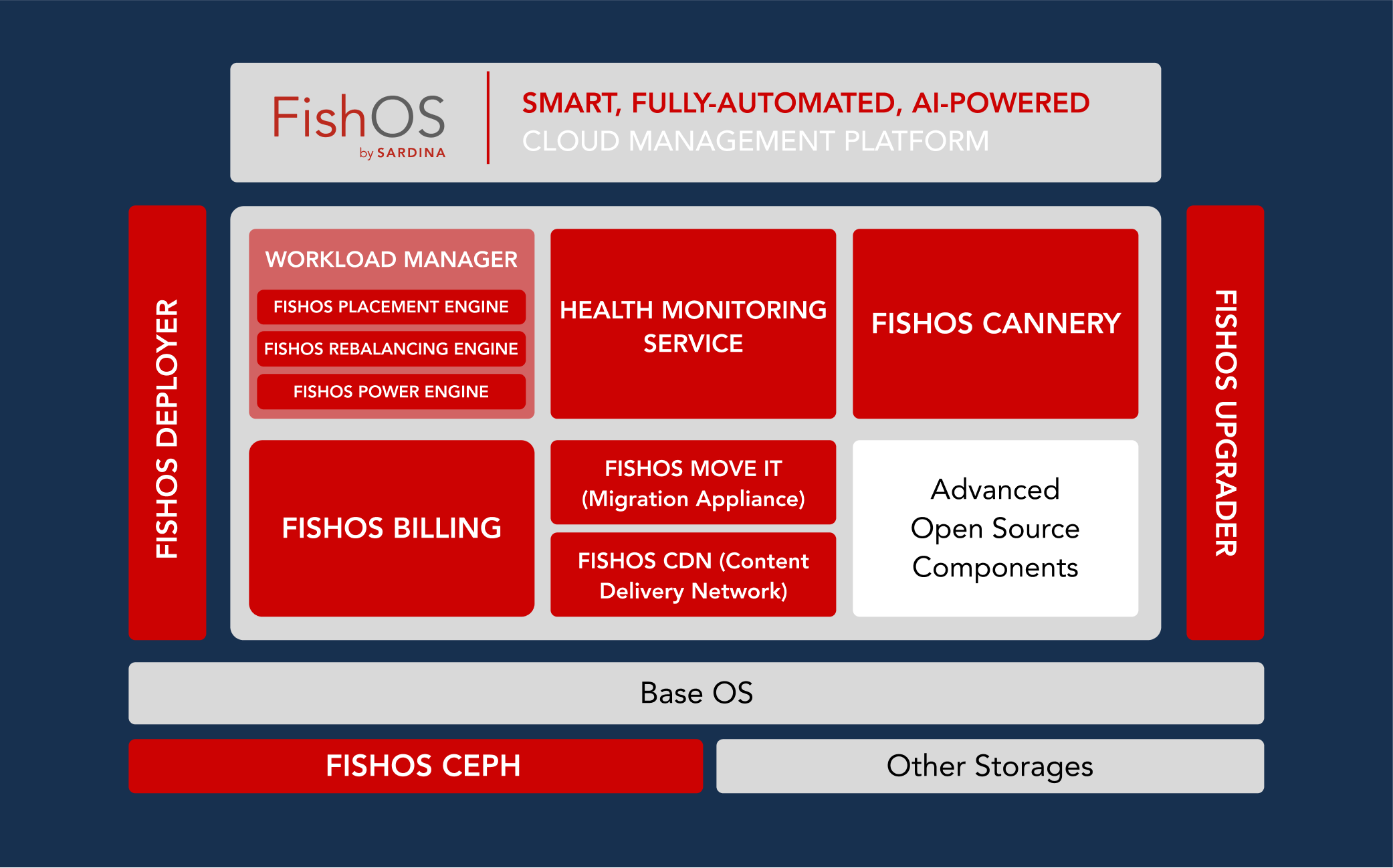
FishOS Product Scheme
Scaling Up: From 10 to 19 Compute Nodes
Initially, VMAccel AI Data Center had been managing its own OpenStack cloud, maintaining an internal support team. Eventually, that burdensome approach proved misaligned with their core business. That led the company to seek a reliable provider, which they found in Sardina Systems.
FishOS was deployed on a system with 10 compute nodes utilizing CPU, GPU, and FPGA technologies. This foundational setup ensured the software could effectively manage the diverse computational demands of AI, machine learning, genomics, and finance. The successful deployment of FishOS established an important performance and reliability baseline, providing opportunities for future scaling.
As VMAccel’s computational demands increased, they decided to expand the system by adding 9 nodes, nearly doubling their infrastructure. This was more than just a quantitative increase in hardware: it was a significant enhancement in the system’s capabilities.
To ensure successful execution, FishOS was first tested for its ability to scale without disrupting ongoing operations. After the tests were completed, the team proceeded to plan the actual upgrade.
The upgrade process was meticulously planned, with a key focus on FishOS’ capability to seamlessly integrate new nodes. Eventually, the platform’s flexible architecture and advanced management features resulted in a flawless execution. New compute nodes were successfully added, and the system expanded from 10 to 19 nodes.
More importantly, the upgrade was executed without any operational downtime. This is a critical factor in industries where even minimal interruptions can lead to significant operational losses.
VMAccel’s Cloud Dynamics and System Upgrades
VMAccel AI Data Center stands out in the cloud computing landscape by providing accelerated cloud as a service. It is an environment where virtual machines (VMs) are continuously created and decommissioned. This is especially important for businesses dealing with rapidly fluctuating workloads, for whom the systems’ uptime and scalability opportunities are top priorities.
In this ecosystem, VMs can have lifespans ranging from weeks to months, which requires a highly adaptable and robust management system.
FishOS excels in this accelerated cloud-as-a-service setup. Its robust architecture allows the platform to handle diverse system loads while ensuring high performance and stability. This is especially important for tasks like AI computations and sophisticated hardware deployments.
In addition, the platform’s stability and reliability are further ensured by the its reliance on OpenStack, a leading open source project.
FishOS enables cloud operators to swiftly create and scale virtual machines with just a few clicks in the interface, seamlessly adapting to fluctuating computational resource demands.
System Upgrades
As part of its commitment to providing the best cloud experience, VMAccel AI Data Center updates its systems to ensure they are secure and include the latest features. In 2023, they collaborated with Sardina Systems to perform a zero-downtime upgrade to the latest OpenStack Zed release. It brought a number of new features, improved performance, and enhanced scalability. The upgrade also provided advanced security features and new APIs and integrations. The new systems upgrade is coming soon.
The successful upgrade was ensured by FishOS Upgrader, a unique component that guarantees a smooth upgrade process without operational downtime.
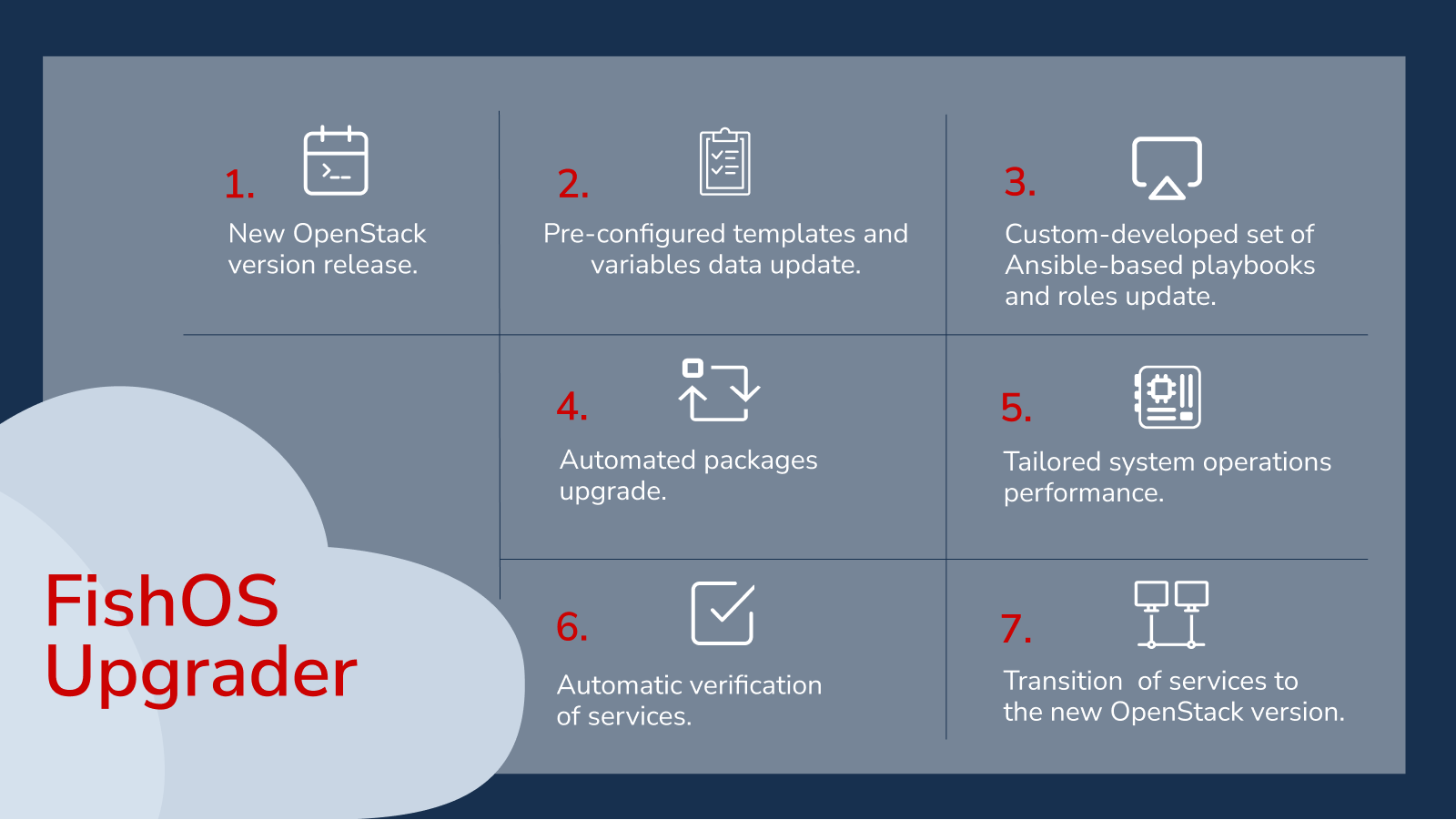
FishOS Upgrader Scheme
- Once a new OpenStack version is available, Sardina Systems’ team prepares new data for integration and aligns it with pre-configured templates and variables from FishOS Upgrader.
- The next step involves a custom-developed set of Ansible-based playbooks and roles to configure system settings. The component sets up the necessary settings, ensuring a smooth upgrade without disrupting ongoing operations. This fully automated process updates packages and data step-by-step and performs additional operations, based on specific system requirements.
- In the end, FishOS Upgrader automatically verifies that all services are up and running and proceeds to seamlessly transitioning each of them to the new OpenStack version.
FishOS Environment for Smooth Operation of Accelerated Cloud
The transient nature of VMs in accelerated cloud environments poses unique challenges. Operators require an intuitive yet familiar setting that simplifies cloud resource management and computations. This need for simplicity and familiarity is critical in ensuring efficiency and minimizing the learning curve associated with managing complex cloud infrastructures.
FishOS, developed by Sardina Systems and based on OpenStack, serves as a cornerstone solution. It is pre-configured to cater to both experienced OpenStack users and newcomers.
For those familiar with OpenStack, FishOS provides a straightforward transition, allowing them to work effectively with the platform and use their expertise from day one. Newcomers, in turn, benefit from FishOS’ user-friendly design, which abstracts the OpenStack complexities while providing access to its full capabilities.
Sardina Systems’ Quote
The ease of use of FishOS has been a game-changer for many innovators and start-ups that VMAccel assisted. Furthermore, the integrated scripting and deployment tooling has enabled VMAccel’s team to move clients’ projects forward in quick iteration cycles.
Moreover, the FishOS license unlocks unlimited consultations from Sardina Systems’ technical support team. This feature is particularly valuable for operators new to OpenStack, as it dramatically streamlines their experience with open source software. They can rely on expert guidance and support to optimize their operations within VMAccel’s dynamic cloud environment.
Health Monitoring for Uninterrupted Operations at VMAccel
VMAccel AI Data Center also benefits from Sardina Systems’ advanced Health Monitoring Service that ensures stable performance and uninterrupted operations. The unique service is a sophisticated combination of open source software components and Sardina Systems’ proprietary Health Engine.
FishOS Health Monitoring is a unique, comprehensive set of components that protects cloud infrastructure from failures. Its data-driven algorithms predict and prevent critical system states.
Several components within Health Monitoring collect metrics and logs and analyse them with proprietary smart algorithms to predict potential health issues. They can process millions of data points per second. If the system is in danger, the component notifies the administrator so that he can act to avoid failure.
For VMAccel’s AI Data Center and Infrastructure, continuous operations are critical, as their global clients heavily rely on uninterrupted deployments. FishOS platform ensures zero disruptions, while Sardina Systems’ support guarantees swift responses to any potential threats posed to customers’ workloads.
What If the System Goes Down?
Even with the most advanced monitoring, unexpected situations might happen. Such event took place once for VMAccel AI data center when an extended power failure of the building caused the entire system, including controllers, to go down.
VMAccel’s quote
Controllers’ challenge and solution: FishOS by default has a high-availability architecture, which helps protect the system from various situations, including prolonged power outages. The only scenario that FishOS cannot recover from is the physical loss of servers, which only happens in extraordinary situations.
The cloud architecture is designed to anticipate problems such as power outages. We use a minimum of three controllers to manage the system simultaneously.
These controllers are interchangeable and mirror each other. If the functionality is interrupted at any stage, the system can identify the latest version and restore all controllers to the required state. Restarting the system after a significant power outage takes an average of 5-15 minutes.
However, controllers are not the most vulnerable part of the system during sudden power outages. The main risk to user data lies with the storage devices. Within a system, storage disks are typically the slowest hardware component. To improve system performance, data is usually written to the disk through cache memory.
Storage challenge: data enters a buffer, then the disk processes and writes it to the permanent storage device. A sudden power outage can prevent data remaining in the buffer from being written to the disk, resulting in data loss. This is a common issue and unfortunately, often irrevocable.
Solutions: To address this problem and protect our client’s data, Sardina Systems developed FishOS Ceph. While FishOS can work with any storage solution, we recommend Ceph, the leading open source software-defined storage solution. This distributed storage system writes data directly to the disk, bypassing the buffer, while maintaining high performance and reliability.
FishOS Ceph, integrated into our software, goes beyond data storage. It is also used for controller operations. This architecture ensures smooth operation even during significant power outages.
Transparent License Terms and the Open Source Power
VMAccel works with a large number of clients from various industries. For them, a strategic approach to budgeting and long-term planning are crucial. An efficient combination of open source technologies and Sardina Systems’ proprietary solutions, enabled VMAccel AI Data Center to offer their customers fair pricing, access to the latest technologies, and freedom from vendor lock-in.
VMAccel’s quote
A notable advantage of the FishOS licensing model is its independence from hardware pricing. Sardina Systems maintains a consistent pricing structure per core regardless of the hardware used, making it cost-effective for both accelerated and traditional cloud environments.
This ensures clients can benefit from high-performance cloud capabilities without incurring premium costs typically associated with accelerated computing environments.
Unlike many proprietary platforms, where hidden costs and extra fees for essential services can escalate quickly, FishOS offers complete transparency and predictability. It provides everything needed at a fixed price for the entire license period, which can extend up to 5 years.
Moreover, all FishOS license levels include comprehensive support, infrastructure development consultations, and system upgrades – at no extra cost.