


Sardina Systems has validated a new CBT-based path in FishOS Move It, adding incremental synchronization to VMware-to-OpenStack migration without VDDK.
Sardina Systems has successfully validated another method for migrating virtual machines from VMware to OpenStack without relying on VMware’s Virtual Disk Development Kit (VDDK). Developed for the FishOS Move It migration appliance, the new path combines VDDK-independent access to VMware disk data with Changed Block Tracking (CBT) for incremental synchronization.
By reducing the amount of data left to transfer at final cutover, the method is designed to shorten the interruption before the workload starts on OpenStack. The CBT-based path has been validated in a test environment and is ready for production deployment with Sardina Systems’ existing customers.
How CBT-based VMware migration narrows the cutover window
A migration begins with a copy of the source VM’s disk data in the destination OpenStack environment. As the VMware VM continues to run, its disks continue to change. CBT identifies the blocks modified since the previous synchronization, so subsequent passes can focus on those changes instead of copying the entire disk again.
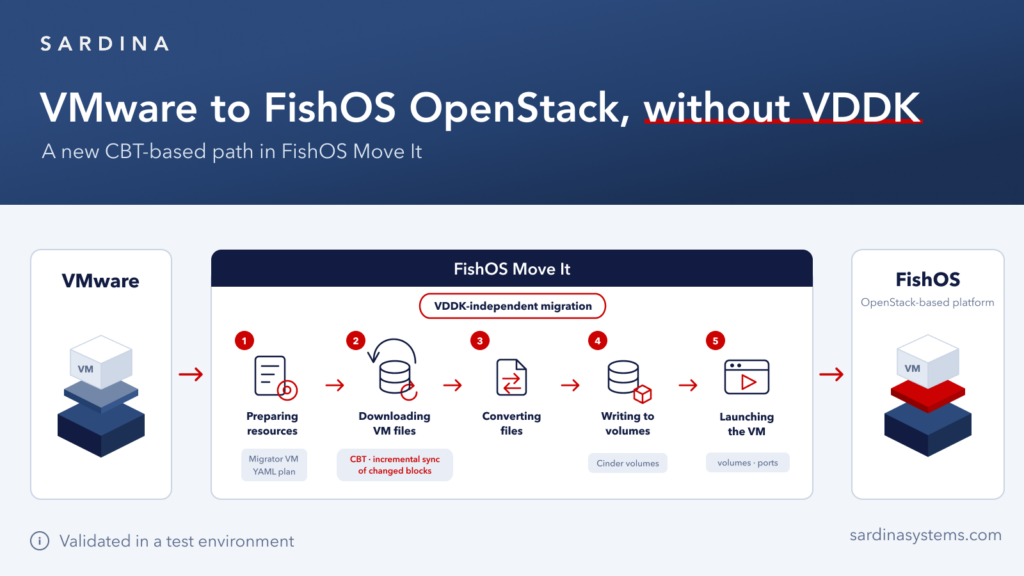
This incremental synchronization leaves less data to transfer during the final cutover. CBT identifies the changes; a separate capability in FishOS Move It provides access to VMware disk data without VDDK.
Why VMware-to-OpenStack migration without VDDK matters now
Changes in the VMware commercial and partner ecosystem have already pushed many organizations to reassess their migration plans. Access to VDDK has added another practical concern: Red Hat reports that the kit is no longer available to end users through standard public downloads, affecting migration workflows that depend on it.
European organizations are weighing both the need for alternatives and the difficulty of moving. In 2026, Belgian digital-technology users’ association Beltug gathered feedback from around 20 organizations for the European Commission. It found that some were extending their VMware contracts while exploring longer-term options. The cost, complexity, and operational risk of migration remained significant concerns.
A separate 2026 survey published by SUSE found that about 55% European IT decision-makers out of 114 respondents were exploring alternatives to VMware or had made the migration decision.
FishOS Move It already supports a VDDK-independent migration from VMware to FishOS and OpenStack, which has already been used in production. The new CBT-based path provides an extra benefit by adding an incremental option for migrations where the final transfer window is especially important.
“We observe two trends at once: organizations actively looking to migrate from VMware, and changes by Broadcom that can make the exit more complex. We believe infrastructure teams should be free to choose the platform that works for them, and we want to support that choice.”
Kenneth Tan, Executive Director, Sardina Systems
Who can benefit from this migration path?
The new option is particularly relevant to cloud and hosting providers, telecom operators, and enterprises with workloads that have narrow maintenance windows, including financial services and healthcare.
For these teams, a migration is not simply a matter of copying a VM. Dependencies, continuously changing data, and each application’s tolerance for interruption all shape the plan.
Planning the move to OpenStack
Even with effective tools, a successful VMware-to-OpenStack migration requires more than a disk transfer. The OpenInfra Foundation’s VMware-to-OpenStack migration guide provides a broader framework for assessing workloads and planning the transition. It proves: migration method is one decision. Operating the destination cloud is another.
The FishOS platform brings deployment, monitoring, upgrades, and workload-management tools to an OpenStack-based environment, among with its own components for usage billing and health monitoring. FishOS demonstrates that moving to OpenStack does not always mean building and operating infrastructure manually.
That being said, the actual downtime depends on the source environment, data volume, network capacity, and workload requirements. That means, every project needs its own assessment, migration, and cutover plan.
Planning a move from VMware to OpenStack? Talk to our engineers about your workloads and a realistic cutover window, with no obligation to proceed. If you choose FishOS as your destination, ask whether your project qualifies for Sardina Systems’ EUR 1 migration offer.