


ASEAN is one of the fastest-growing digital economies in the world, projected to approach 1 trillion USD by 2030. For both local players and international firms, the opportunities are undeniable, but capturing them depends heavily on choosing the right cloud infrastructure model.
Today, most enterprises default to public cloud, drawn by promises of scalability and speed. Public cloud indeed remains the fastest way to spin up infrastructure and test ideas.
However, in ASEAN, this choice often comes with a paradox: public cloud is more expensive here than in the U.S., even though labor, electricity, and land are cheaper across much of the region. Colocation, the traditional alternative, fares no better, with heavy upfront costs and long deployment cycles that don’t match ASEAN’s dynamic markets.
This article explores the ASEAN cloud market landscape, explains the true shape of Total Cost of Ownership (TCO), and shows why enterprises should shift toward private cloud for a model that delivers speed, sovereignty, and cost efficiency.
ASEAN Cloud Market: Fast Growth, Complex Realities
The ASEAN cloud computing market is set to double from USD 21.78 billion in 2025 to USD 43.06 billion in 2030 at a CAGR of 14.6% (Mordor Intelligence). Singapore anchors demand with its mature digital ecosystem, while Vietnam is the fastest-growing market. Chinese hyperscale providers are also expanding aggressively, with huge regional investments in infrastructure build-out across Indonesia, Malaysia, and Thailand.
This growth is powered by:
- 5G edge deployments that enable low-latency services
- Government-led digital transformation programs
- Healthcare and telecom demand, which are among the fastest adopters
- Emerging colocation hubs like Jakarta, now one of the fastest-growing globally
Yet ASEAN is not a single market: it is 10 countries with diverse regulations, labor costs, and technical capabilities. What works in the U.S. or Europe cannot simply be replicated here.
Key challenges include:
- Regulatory diversity: Countries like Indonesia, Vietnam, and Malaysia enforce strict data localization rules, and some have built local cloud platforms to ensure sensitive data stays within national borders.
Labor market dynamics: Talent is costly in Singapore but far cheaper in Vietnam or the Philippines.
Skill gaps: Some markets lack in-house expertise and experience to manage complex multi-cloud deployments.
These differences mean enterprises must carefully design infrastructure strategies that balance speed, cost, and control instead of copying “U.S. playbooks.”
Three Cloud Paths in ASEAN and How TCO is Shaped
When building or expanding infrastructure in ASEAN, enterprises essentially have three core deployment models:
- Public Cloud – by far the most popular option today, holding a 67.6% market share in 2024.
- Hybrid Cloud – growing at a 16.2% CAGR through 2030, driven by regulatory pressures and multi-cloud governance needs.
- Private Cloud – still strong in highly regulated sectors such as banking and healthcare, but often overshadowed by hyperscalers.
At first glance, the public cloud looks like the easiest route: fast to deploy, flexible, and scalable. But the real cost picture is more complicated.

First, let’s see how Total Cost of Ownership (TCO) is typically shaped in ASEAN:
- CapEx (Capital Expenditure): hardware purchases, colocation contracts, and initial setup fees.
- OpEx (Operational Expenditure): recurring monthly bills for cloud services, power, cooling, and staffing.
- Additional Costs: compliance audits, cross-border data transfer fees, integrations, and vendor lock-in penalties.
This baseline applies to any deployment model. But in public cloud, enterprises pay well beyond TCO, often for reasons unrelated to their own efficiency.
Public Cloud: Why It’s Expensive Where It Shouldn’t Be
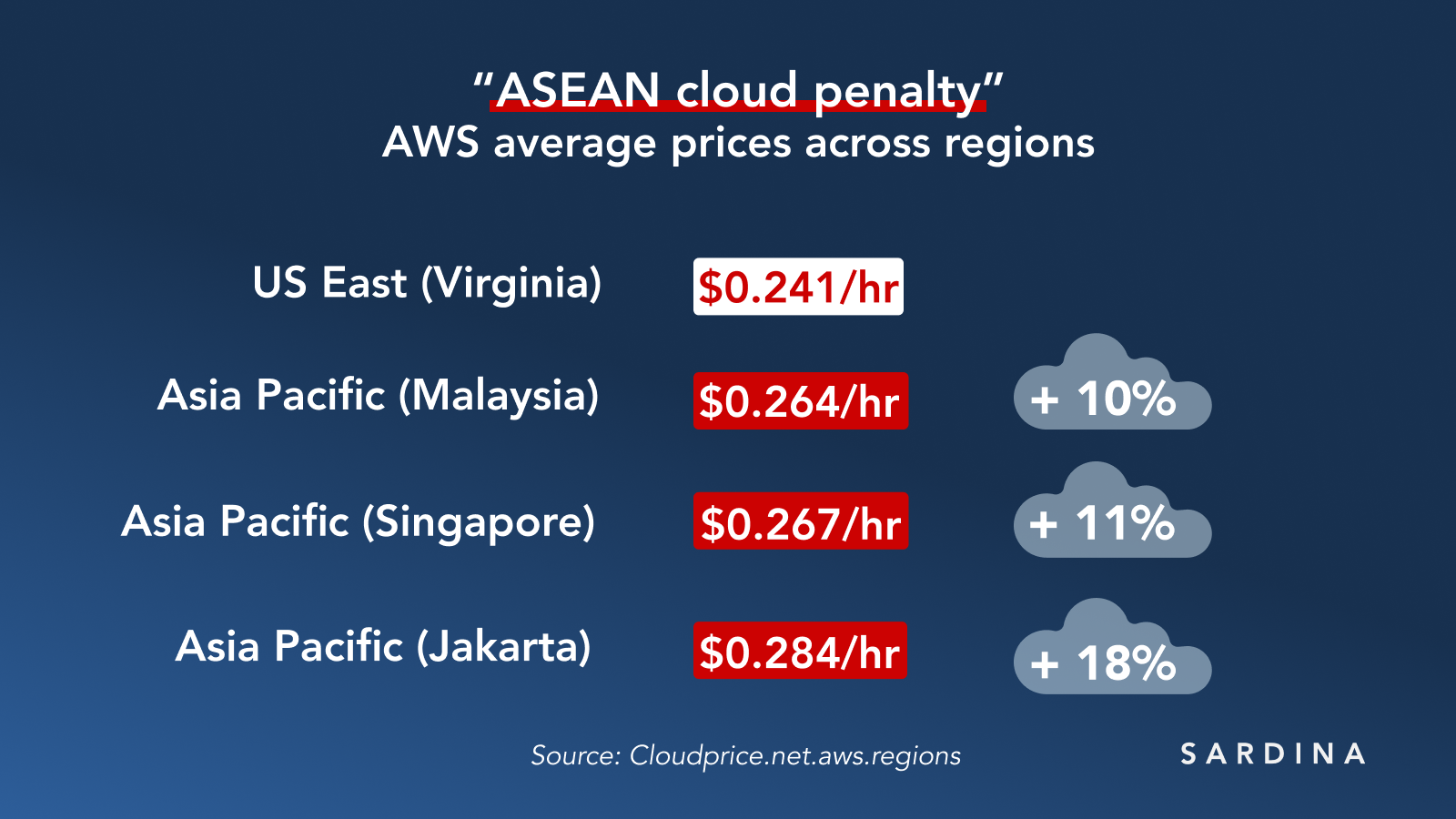
Public cloud pricing in ASEAN defies local economic logic. AWS, for example, benchmarks its rates against US East (N. Virginia) but charges higher prices in Asia Pacific regions:
Even network egress (the outbound traffic leaving the cloud to users and applications) is more expensive in ASEAN. For example, AWS EC2 data transfer beyond free quotas costs $0.09/GB in US East (N. Virginia), compared to $0.12/GB in Singapore, $0.132/GB in Jakarta, and $0.17/GB in Sydney.
In other words, ASEAN enterprises pay more for cloud services in a region where labor, energy, and real estate costs are actually lower than in the U.S. Instead of benefiting from local cost structures, businesses are subsidizing hyperscalers’ global investments.
So what are enterprises really paying for?
- Hyperscaler investments: AWS, Microsoft, and Google have invested over USD 20 billion across ASEAN since 2024.
- Global supply chains: Costs spread across global operations, not just ASEAN.
- Convenience premium: Instant deployment and elasticity, but limited customization.
- Hidden costs: Data egress fees, unpredictable billing, vendor lock-in.
The result is what many call the “ASEAN cloud penalty”: higher costs and less control.
Colocation: Control at the Wrong Price
Colocation, another alternative, promises control but comes with other challenges:
- Heavy upfront CapEx for servers, racks, and facilities.
- Slow deployment timelines, often taking 6–12 months to go live.
- Rigid capacity planning, when enterprises risk over-investing in underutilized hardware.
This model remains ill-suited to ASEAN’s fast-moving, diverse digital landscape.
Why the Market Must Shift Toward Private Cloud
ASEAN enterprises need infrastructure that balances speed, control, and cost-efficiency, and private cloud delivers just that.
- Lower and predictable TCO compared to public cloud
- Typically quicker time-to-production than colocation
- Full operational sovereignty for compliance and performance
- Scalability without hyperscaler pricing traps
Sardina Systems’ FishOS cloud management platform has been supporting enterprises in ASEAN for over a decade, delivering infrastructure aligned with local realities.
What FishOS offers:
- Predictable OpEx: Per-core licensing, no hidden fees
- Automated deployment: Full support from the Sardina Systems team ensures seamless rollout in days (not even weeks)
- Complete control: Enterprises manage networking, storage, and compute directly
- On-demand scalability: Grow from test environments to enterprise scale without pricing surprises
- Open-source foundation: Built on OpenStack, Kubernetes, and Ceph for flexibility and customization
In ASEAN, this means infrastructure that’s aligned with local costs, adaptable to local regulations, and free from hyperscaler lock-in.
Conclusion: Time to Rethink the Cloud Choice
The ASEAN digital economy is accelerating, but enterprises can’t afford to build their future on misaligned cost structures. Public cloud inflates bills where costs should be lower, while colocation provides quite a rigid infrastructure.
Private cloud offers a smarter alternative: predictable costs, faster rollout, and full control. With FishOS, enterprises don’t just get infrastructure, but also the flexibility to grow in ASEAN on their own terms.
Book a free consultation with the Sardina Systems team and discover how FishOS can transform your TCO in ASEAN.