

Ceph is a powerful, scalable software-defined storage (SDS) solution, widely adopted in cloud and enterprise environments. However, like any complex system, it has its challenges. Here, we address six critical concerns about Ceph’s weaknesses and provide a balanced perspective.
1. Is Ceph Really Slow? A Closer Look at Hardware and Efficiency
The claim that Ceph is slow often comes down to hardware differences rather than Ceph itself. One of Ceph’s key advantages is its hardware compatibility, allowing clients to run it on virtually any setup without vendor lock-in. However, this flexibility can also lead to unfair comparisons — Ceph is sometimes benchmarked on outdated hardware against proprietary software-defined storage solutions running on higher-end infrastructure.
Another factor is hardware consumption — how much hardware Ceph requires compared to its competitors. While this varies case by case, many vendors don’t disclose detailed hardware requirements. From our experience, we often outperform competitors in hardware efficiency for our customers. Ceph’s flexibility allows us to adapt configurations to meet the same capacity using different hardware setups, optimizing for performance, cost, or power efficiency.
For instance, one of our clients needed a 983TB backup storage system across 16 servers and was evaluating both WEKA and FishOS Ceph. Their WEKA setup used a 14+2 redundancy profile, distributing data across 14 nodes with 2 for parity. Each node had six 15TB NVMe drives and required 128GB RAM (20GB per NVMe).
For Ceph, we applied a 12+4 erasure coding scheme, storing data across 12 nodes with 4 for redundancy. By using three 30TB NVMe drives per node, we cut RAM usage to 64GB per node — a 50% reduction compared to WEKA, while maintaining scalability and resilience.
2. Does Ceph make sense with fewer than five servers?
Ceph is designed for scalability and fault tolerance, making it most effective in larger deployments. Running Ceph with fewer than five servers can limit its ability to distribute data efficiently, impacting redundancy and performance.
That said, Ceph can still work in smaller setups with careful tuning. Adjustments such as erasure coding and a lower replication factor can optimize resource usage. While high-performance configurations may require NVMe drives and high-bandwidth networking, such demands are common among SDS solutions aiming for enterprise-grade performance.
3. Do large deployments face significant challenges with Ceph?
Some companies operating Ceph at scale have reported challenges.
However, many large-scale cloud providers and enterprises have successfully scaled Ceph by leveraging its flexibility and robust architecture.
Scaling Ceph effectively requires expertise in cluster design, performance tuning, and monitoring. Organizations that invest in automation, proper hardware selection, and best practices often achieve stable and efficient large-scale deployments.
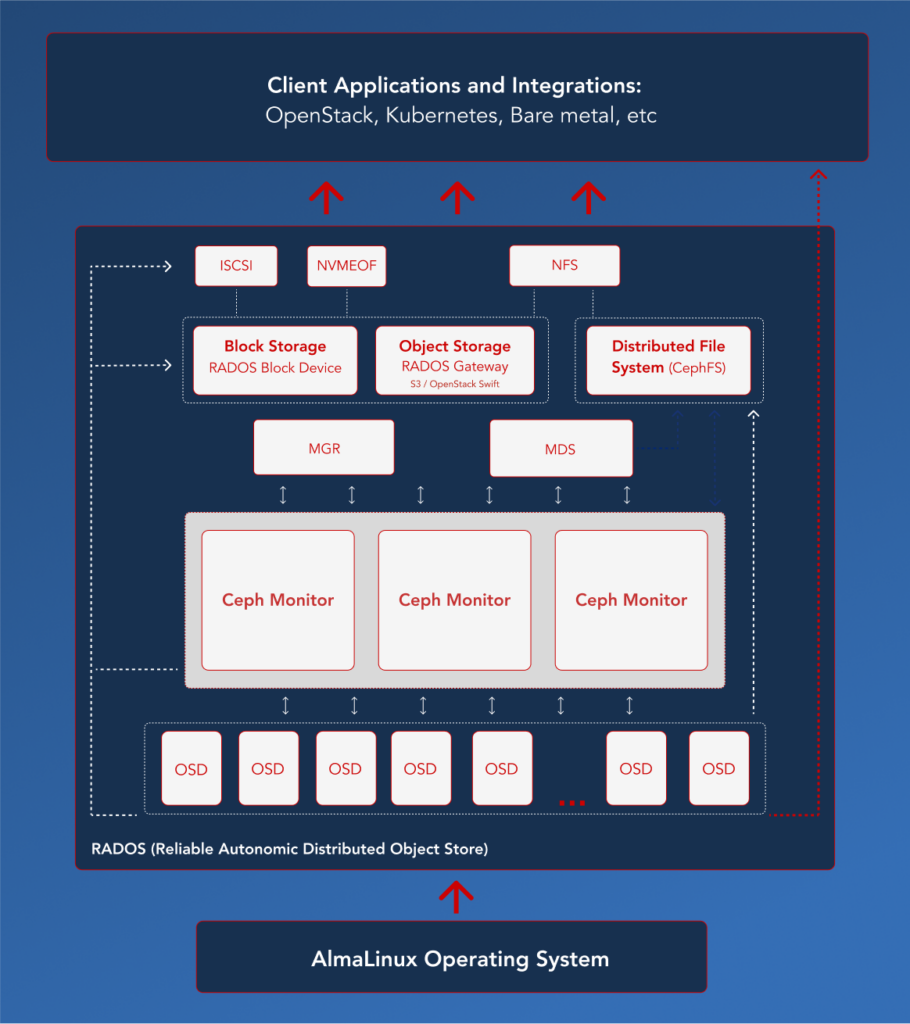
4. Is Ceph unsuitable for databases and modern scale-out applications?
Ceph’s design — distributing data across nodes — introduces latency and limits IOPS, making it less ideal for high-performance databases. Applications like Cassandra, MongoDB, and Kafka, which depend on their own high-availability mechanisms, may face compatibility challenges when deployed on Ceph.
However, Ceph excels in workloads prioritizing scalability, such as cloud-native applications, data lakes, and archival storage. Performance-sensitive workloads can benefit from proper tuning, high-speed storage (e.g., NVMe), and optimizations like BlueStore. Additionally, integrations with Kubernetes (via Rook) and OpenStack allow enterprises to leverage Ceph’s strengths while accommodating workload-specific needs.
5. Does Ceph’s design clash with modern infrastructure trends?
Ceph follows a distributed SAN approach, separating compute and storage — a model that contrasts with converged infrastructure trends where applications and storage share the same nodes. While convergence offers efficiency in some scenarios, Ceph’s separation of roles provides greater flexibility, particularly for organizations with diverse and evolving infrastructure needs.
Originally designed for smaller drives, Ceph’s sharded data model has evolved to support modern hardware, including high-capacity storage and NVMe. Features like erasure coding further optimize utilization, making Ceph adaptable to today’s large-scale environments.
6. Is Ceph too complex to manage effectively?
Ceph’s flexibility allows it to serve block, object, and file storage in a unified system — but this versatility comes at the cost of complexity. Deploying and maintaining Ceph requires engineering expertise, making it less appealing for organizations without dedicated storage teams.
However, Ceph’s ecosystem has matured significantly. Documentation and enterprise support from vendors like Sardina Systems, reducing adoption barriers. While the learning curve remains steep, organizations can now access extensive training resources, community forums, and professional support to build expertise and ensure long-term stability.
Ceph is not a one-size-fits-all solution, but it remains a strong choice for organizations prioritizing scalability, flexibility, and cost efficiency. Its challenges —hardware demands, performance tuning, and operational complexity — are manageable with the right strategy and expertise. For those willing to invest in learning and optimization, Ceph continues to be a compelling SDS option.
Building an efficient storage architecture requires careful planning, and success depends on many fine details. While some deployments struggle, it doesn’t mean yours will. At Sardina Systems, we work closely with clients to tailor their storage setup, ensuring the best balance of performance, reliability, and cost-efficiency.
If you’re evaluating storage solutions, let’s discuss how to optimize yours.