


In today’s digital economy, organizations rely on data centers not just for capacity and uptime, but also for compliance and trust. Certifications may not always be mandatory, but for many customers, they are non-negotiable. Certifications validate that your infrastructure meets rigorous standards for security, availability, operational resilience, and regulatory compliance.
If your cloud infrastructure runs on FishOS by Sardina Systems, achieving compliance becomes significantly more manageable. In this article, we explore the most widely recognized data center certifications, explain their relevance, and highlight how FishOS supports your path to certification.
Key Certifications for Data Centers and Cloud Providers
Foundational Certifications:
- Uptime Institute Tier Certifications: Measure the redundancy and reliability of data center infrastructure.
- SOC 1 / SOC 2 / SOC 3 (System and Organization Controls): Assess controls related to financial reporting (SOC 1) and trust service principles like security, availability, and confidentiality (SOC 2 and 3).
- ISO/IEC 27001: The leading standard for information security management systems (ISMS), required for many enterprises and highly regulated industries.
- ISO 50001: Focuses on energy management, guiding data centers toward improved energy efficiency and reduced environmental impact.
Use Case-Specific or Regional Certifications:
- PCI-DSS (Payment Card Industry Data Security Standard): Required for environments handling payment card data.
- HIPAA (Health Insurance Portability and Accountability Act): Applicable to data centers processing healthcare data in the U.S.
- FedRAMP / FISMA / ITAR: Mandated for cloud services used by U.S. federal agencies.
- LEED (Leadership in Energy and Environmental Design): Recognizes sustainability and energy efficiency.
Each of these certifications targets different priorities, from security and privacy to energy and sustainability. However, they all share a core focus on governance, risk management, and operational excellence.
What These Certifications Have in Common and How FishOS Helps
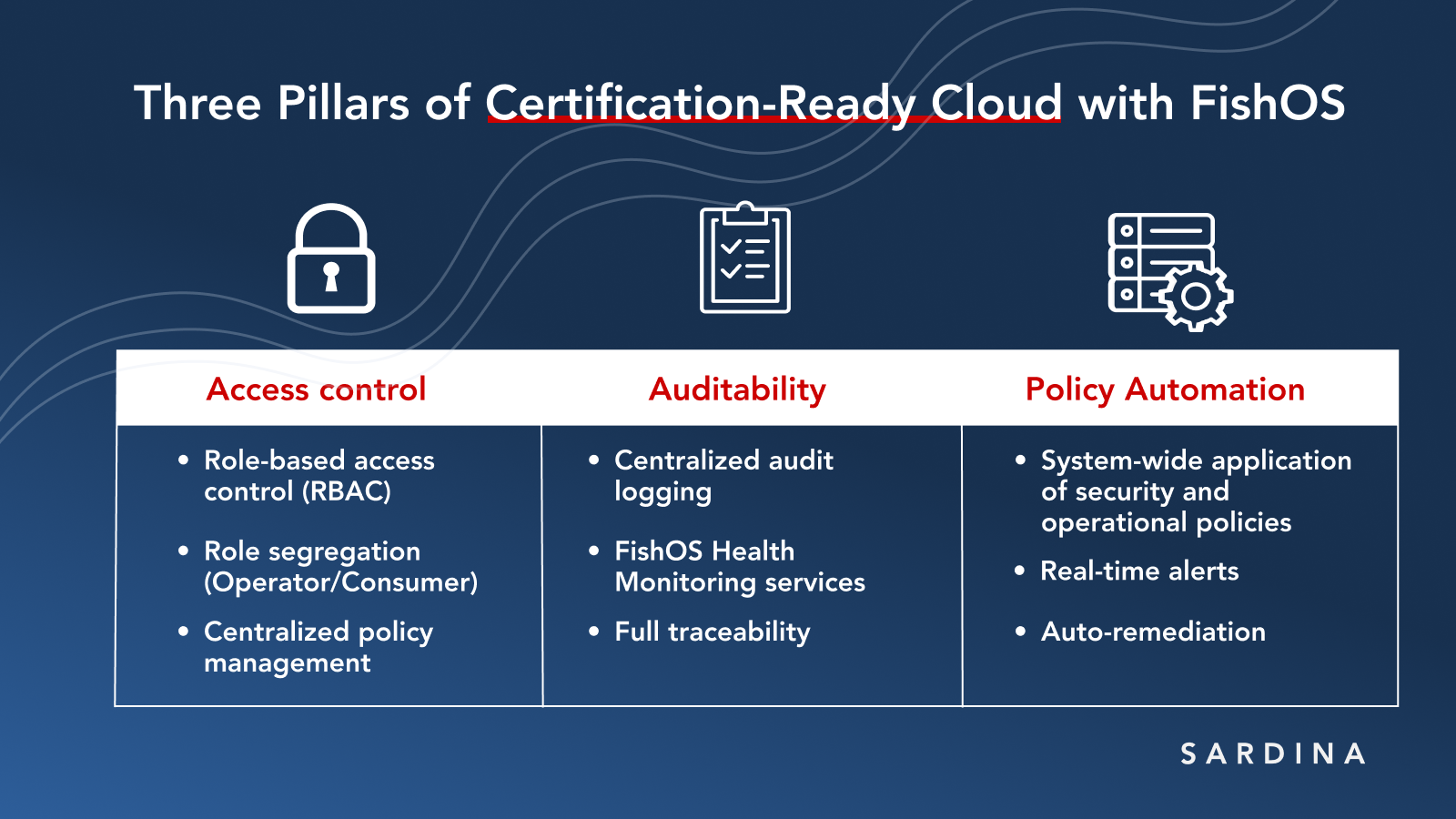
Despite their variety, most data center certifications emphasize three foundational principles: access control, auditability, and policy enforcement.
FishOS cloud management system, built on OpenStack and enhanced with enterprise-grade features, provides the necessary tools to support all three pillars of compliance. Designed for large-scale, production-grade cloud environments, FishOS simplifies and standardizes many of the operational and security tasks required for regulatory certification.
Let’s take a closer look:
- Access Control: Define and enforce who is allowed to perform which actions, whether it’s an operator or an end user.
FishOS offers:
- Clear segregation of roles with the Service Operator being responsible for the provision of a virtualized computing environment, and the underlying infrastructure necessary for the service, while the Service Consumer is only concerned about and responsible for the virtualized computing environment.
- Role-based access control (RBAC) and centralized policy management ensure consistent access governance across all cloud services.
- Auditability: Maintain comprehensive records of actions taken across the system for traceability and accountability.
FishOS offers:
- Centralized audit logging and monitoring, capturing every user and system-level action across the infrastructure.
- Real-time visibility into system performance and incidents with data-driven FishOS Health Monitoring services.
- Policy Automation and Enforcement: Detect and respond to non-compliant behavior in real time through automated controls and alerts.
FishOS offers:
- Toolings allowing service operators to gain a robust framework for applying their own security and operational policies across the entire infrastructure.
- By giving operators the tools to configure policies according to their unique requirements, FishOS ensures compliance and operational consistency while keeping policy ownership firmly in the hands of those who know their environment best.
How FishOS Components Support Broader Certification Goals
FishOS includes built-in High Availability (HA) that helps cloud infrastructure remain resilient even under load. It also integrates a range of advanced components that further support your journey toward certification and operational maturity.
- FishOS Workload Manager dynamically balances workloads to reduce energy consumption and improve system utilization. Supports sustainability targets and aligns with standards such as ISO 50001 and LEED.
- FishOS Upgrader enables non-disruptive OpenStack upgrades with zero downtime to operations, ensuring your systems remain secure, stable, and up to date without impacting services.
- FishOS Health Monitoring proactively tracks and analyses system health and predicts issues before they impact the performance.
FishOS also includes Ceph, a highly scalable and reliable storage solution. Its distributed architecture ensures data durability and availability, critical for meeting certification requirements related to backup, disaster recovery, and high availability.
Real-World Example: Meeting ISO/IEC 27001 Requirements with FishOS
The ISO/IEC 27000 family offers a framework for information security management and is among the most relevant for data centers and cloud infrastructure providers.
ISO/IEC 27001 specifies the requirements for establishing, implementing, and maintaining an ISMS. FishOS supports this standard by giving operators the tools needed to enforce security controls, manage identity, and monitor system activity.
Several Sardina Systems customers across Europe, Asia, and the United States have attained ISO 27001 certifications using FishOS.
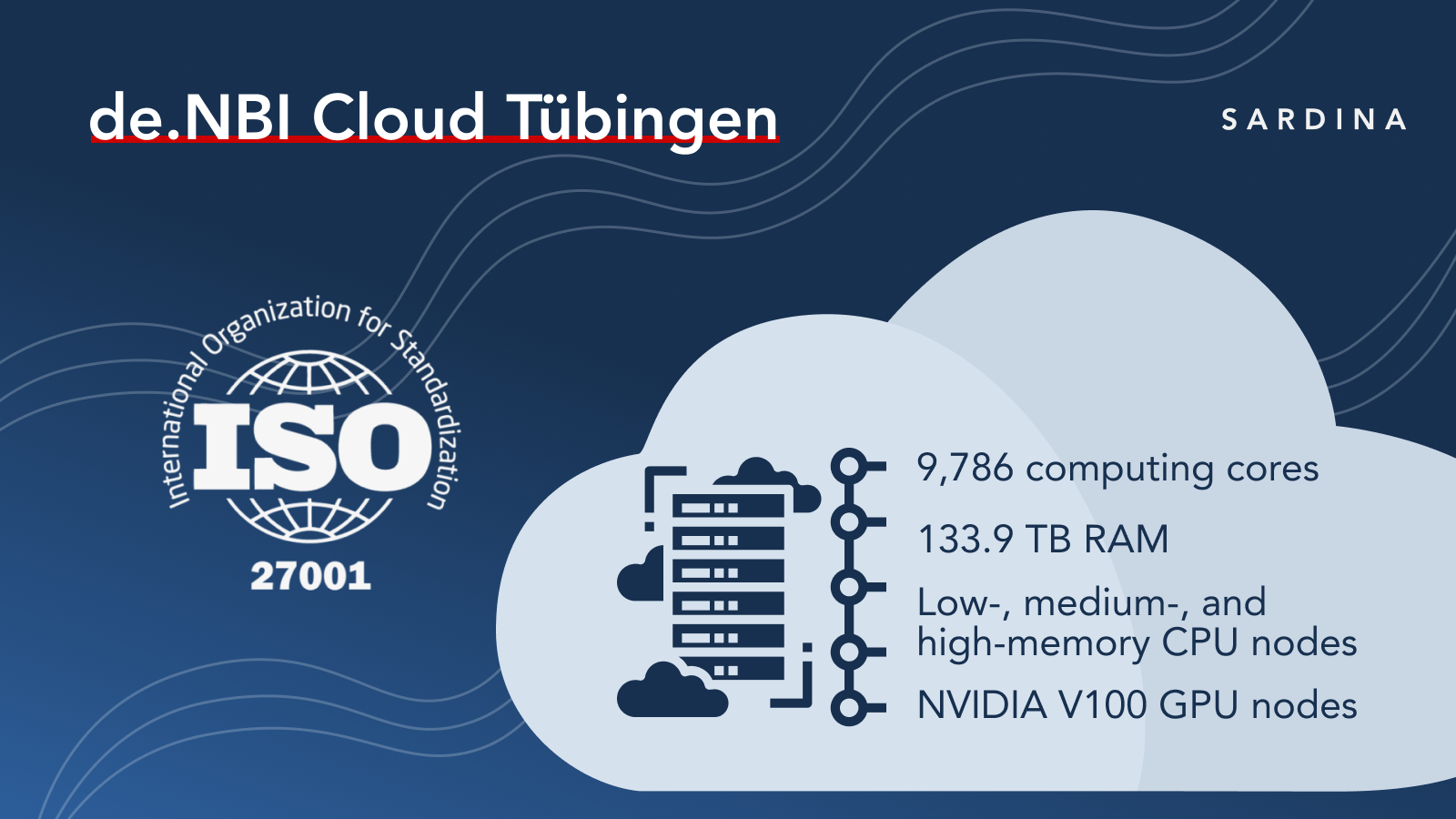
One example is the de.NBI Cloud site in Tübingen, part of the German Network for Bioinformatics Infrastructure, that successfully achieved ISO/IEC 27001:2022 certification using FishOS. Their team independently configured the platform to meet the updated requirements, implementing secure authentication systems, physical access controls, and more.
Another notable certified site in the region is GRASS-MERKUR, a leading German data center services provider with facilities in Hanover, holding multiple ISO certifications.
Other key standards in the ISO/IEC 27000 family include:
- ISO/IEC 27017 focuses on cloud-specific information security controls for multi-tenant environments.
- ISO/IEC 27031 provides guidance for business continuity and disaster recovery planning, essential for minimizing downtime and data loss.
Why FishOS is a Strategic Choice for Certification-Driven DCs
Achieving certification is more than a compliance task, but a signal of operational maturity, customer trust, and competitive advantage. Whether you’re supporting enterprise clients, launching a regulated private cloud, or optimizing for energy efficiency, FishOS equips your data center with the automation, visibility, and control needed to meet certification standards.
If certification is on your roadmap, FishOS can help you get there with confidence and speed. Contact us today to schedule a complimentary consultation with Sardina Systems’ experts and discover how we can assist your certification journey.