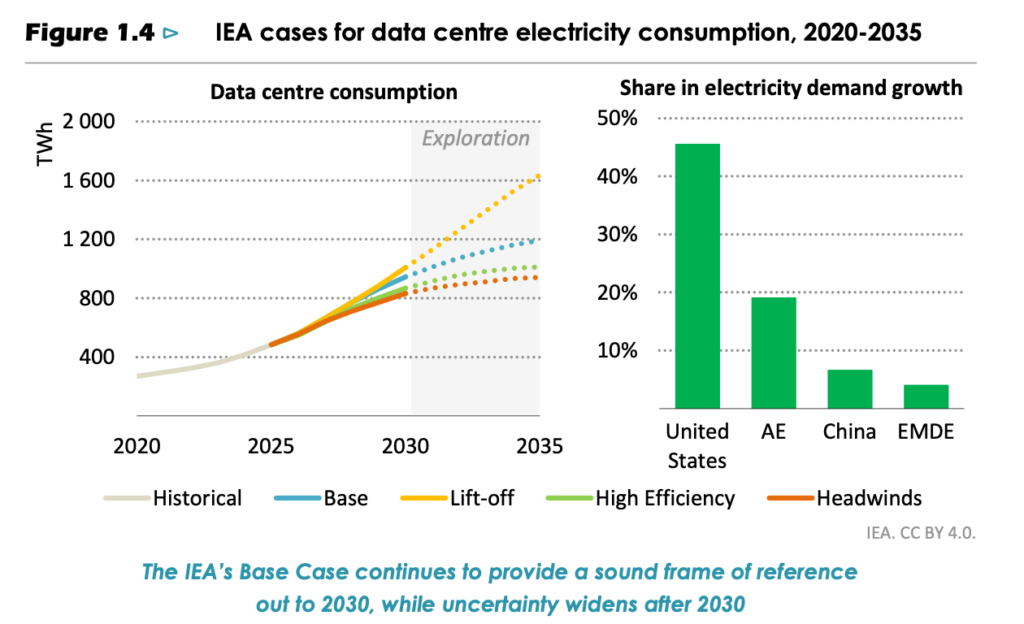
In 2025, global data centre electricity consumption grew by 15%. AI-focused facilities grew faster still — up 50% in a single year. The IEA’s latest report, Key Questions on Energy and AI (April 2026), puts the updated trajectory plainly: consumption will roughly double and reach almost 500 TWh in 2025 to 950 TWh by 2030, with AI-specific infrastructure tripling over the same period.
Five technology companies now spend more on data centre investment than the entire US oil and gas industry spends on production. The infrastructure race is real, the energy implications are immediate, and the tools most operators rely on to manage efficiency are not keeping pace.
AI efficiency is improving — and that is not solving the problem
Energy use per AI query has dropped by at least an order of magnitude annually in recent years. A simple text query today consumes less electricity than running a television for the same duration. If every conventional internet search were replaced by an AI text query, the total energy cost would be under 4 TWh annually — less than 1% of current data centre consumption.
The catch: the queries getting cheaper are not the queries driving growth. Video generation, multi-step reasoning, and agentic tasks — where an AI model autonomously completes sequences of actions — consume hundreds or thousands of times more energy per query than simple text generation. Major model providers reported a threefold increase in active users and a fivefold increase in revenue over the past year. More users running heavier tasks erases the per-query efficiency gains. The IEA frames it as three competing trends: improving efficiency, surging uptake, and increasingly energy-intensive use cases. All three are accelerating simultaneously.
Power density is hitting the physical limits of current technology
Between 2020 and 2025, the power density of AI servers increased elevenfold. By 2027, it is projected to increase further fourfold. An individual server rack in an advanced AI data centre — roughly the size of a large refrigerator — could by 2027 draw peak power equivalent to 65 households. It is an engineering constraint that is already reshaping data centre design, supply chains for power electronics and transformers, and the economics of cooling.
This is why liquid cooling has shifted from optional to structural. Air cooling handles rack densities up to 20 kW under standard conditions, and up to 40 kW with precision cooling infrastructure. It is not adequate at the densities AI infrastructure now requires. The transition is happening, but it is concentrated in new hyperscale builds. The majority of the installed base — enterprise and co-location facilities built for a different era — is still running air-cooled infrastructure, paying full cooling costs regardless of actual load.
Renewables are growing, but gas fills the gap
The tech sector signed around 40% of all corporate renewables power purchase agreements globally in 2025. The pipeline of data centre offtake agreements with small modular reactors has grown from 25 GW at the end of 2024 to 45 GW by the end of 2025.
The first SMR projects are not expected to come online until around 2030. Grid connection queues stretch years in most advanced economies. Transformer and power electronics supply chains are under strain from a 70% surge in gas turbine orders in 2025 alone.
In the meantime, data centre developers in the United States are advancing onsite natural gas generation at scale. IEA satellite tracking shows that around one-fifth of these projects have already started land clearing or construction. The IEA’s own analysis finds that reliably supplying variable AI load from onsite gas requires overbuilding generation capacity by 30% to 70% relative to actual demand — an inherently inefficient solution adopted because the grid cannot move fast enough.
The lever nobody is measuring: what servers actually do with the power they receive
The IEA report, like most industry analysis, focuses on supply-side questions: where does the electricity come from, how is it delivered, and how is heat removed. These are real problems. But they sit downstream of a more fundamental one.
Server utilisation — how much of installed compute capacity is doing useful work at any given time — is among the least reported metrics in the industry. The IEA explicitly flags the need for more systematic energy consumption disclosures from technology companies. Uptime Institute’s 2025 survey found that only 37% of operators track server utilisation as a sustainability metric — down from 41% the year before. A facility running servers at low utilisation pays the full cost of electricity and cooling around the clock, regardless of load. Better cooling and greener electricity reduce the cost of that waste.
This is where cloud architecture becomes part of the conversation. How workloads are placed, scheduled, and consolidated — whether on public infrastructure or private — directly determines how much compute is active at any given moment. Private cloud platforms with ML-driven workload placement give operators direct visibility and control over that equation: fewer active nodes under the same workload, lower energy draw, lower OpEx. Not as a green initiative. As an operational decision with measurable consequences on the electricity bill.
The industry narrative on AI energy consumption centres almost entirely on procurement: renewable certificates, nuclear offtake agreements, and next-generation cooling. These matter. But none of them address what happens inside the facility once the power arrives. Utilisation is the gap between the electricity bill and the useful work done. Closing it requires visibility into workload placement — and the willingness to treat compute efficiency as an operational priority rather than a reporting footnote. The operators who move first on that decision will simply have lower electricity bills.