


In an era where data is rewritten, overwritten, and sometimes quietly erased, immutable storage draws a hard boundary: once data is written, it stays untouched.
This isn’t just a technical feature—it’s a structural guarantee. Immutable storage ensures that files, logs, backups, or critical records cannot be altered or deleted, whether by malware, human error, or malicious intent. It’s not about preventing access; it’s about protecting truth, ensuring that certain data tells the same story tomorrow as it does today.
While the market often highlights solutions like Amazon S3 Object Lock for block-level immutability, such offerings come with high costs and potential vendor lock-in.
As an alternative, we present an open-source, cost-efficient solution that delivers enterprise-grade immutability without compromising flexibility.
This approach empowers organizations to implement secure, compliant, and budget-conscious data protection without being tied to proprietary ecosystems.
Why Immutable Storage Is Becoming Non-Negotiable
Once seen as a specialist feature for banks and archivists, immutable storage has moved into the mainstream of infrastructure planning. The reason is simple: the nature of digital threats has changed.
Ransomware is no longer about quick smash-and-grab encryption. Attackers now aim to dismantle recovery systems themselves—seeking out backups, snapshots, and archives to ensure there’s nothing left to restore. If the data isn’t locked, it’s vulnerable.
Immutability shifts the balance. By enforcing “write once, read many” rules, it freezes critical data for a set period, making it immune to tampering or deletion, no matter who gets in. Even with elevated privileges, the locked data stands outside an attacker’s reach.
This isn’t theory. In post-mortems of high-profile incidents, investigators often find the same pattern: backups weren’t truly immutable, and attackers exploited that to turn an IT crisis into an existential threat. Without this safeguard, a backup is just another file to encrypt.
In FishOS Ceph, Object Lock bakes immutability into the storage fabric itself. Combined with disciplined operational controls, it forms a barrier that ransomware campaigns cannot easily breach, ensuring that when everything else goes wrong, there’s still a clean, untouchable copy to rebuild from.
Ceph and Immutable Storage: Open-Source Control with Enterprise-Grade Security
Ceph is a scalable, open-source, software-defined storage system built to handle modern data workloads across object, block, and file. Through its S3-compatible RADOS Gateway (RGW), Ceph brings native support for Object Lock, allowing organizations to implement WORM (Write Once, Read Many) protection at the object level.
This functionality is especially critical for compliance-heavy environments like finance, government, legal services, and healthcare. Combined with bucket versioning, Object Lock allows precise control over object retention, guarding against ransomware, insider threats, or accidental deletion.
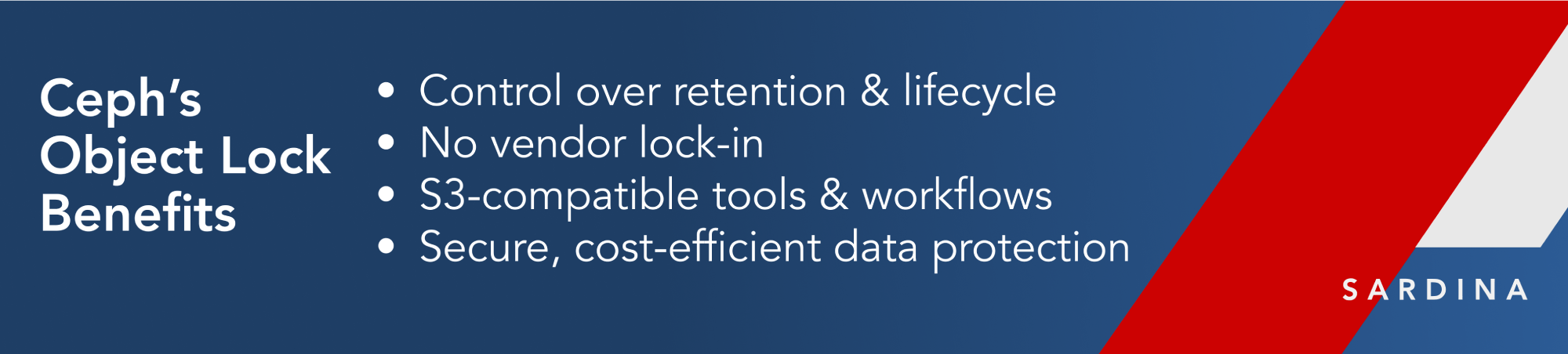
Fine-Grained Control: Governance and Compliance Modes
Ceph’s Object Lock offers two retention modes to match different regulatory and operational needs.
Governance Mode acts as a soft lock: standard users cannot delete or alter protected data during the retention window, though administrators with the right permissions can override it. It’s ideal for internal policies, operational data, or backups.
Compliance Mode is a hard lock: no user can modify or delete the object before the defined retention period expires. It’s the mode of choice for legal archiving and strict compliance mandates such as SEC 17a‑4, HIPAA, or FINRA.
These modes are enhanced by two control layers:
- Retention Period: Sets a specific time frame during which an object remains immutable. In Compliance Mode, it cannot be shortened or bypassed.
- Legal Hold: A manual flag that overrides expiration and retains data indefinitely, regardless of retention settings. Used during legal investigations or audits.
Continuous Development: Evolving Object Lock in Ceph
Ceph’s Object Lock features continue to mature. One notable enhancement is support for the PutObjectLockConfigurationAPI, allowing organizations to enable Object Lock on existing versioned buckets, even if they weren’t originally created with lock support.
What does this mean in practice?
- No need for bucket migration – immutability can be retroactively applied to live buckets without disruption.
- Improved compliance readiness – businesses can quickly adapt to new regulatory requirements without re-architecting infrastructure.
- Stronger ransomware defense – historical data can now be locked down after the fact.
- Better automation support – API-driven control makes it easier to integrate immutable storage into CI/CD and backup pipelines.
Going Further: FishOS Ceph Hardens Immutability
Turning on Object Lock is a strong start, but true immutability requires more than just API-level enforcement. It demands operational discipline, infrastructure-level controls, and a trusted vendor capable of delivering secure-by-default architectures.
To fully protect data from deletion, tampering, or privilege misuse, organizations must go beyond the interface and close every potential back door.
Locking Down the Admin Console
Ceph is incredibly powerful, but with that power comes risk. Admins can, if left unchecked, bypass protections using low-level tools like radosgw-admin or even directly manipulate object pools.
Mitigation starts with:
- Strict role-based access control (RBAC)
- Limiting sudo privileges on sensitive tools and commands
- Separating admin responsibilities across different Ceph layers (e.g., CephFS vs. RGW)
- Enabling detailed audit logging via Ceph’s built-in audit tools or external platforms like ELK or Loki
Keeping RADOS Access Off-Limits
Object Lock protections only apply at the RGW layer. With direct RADOS access, even immutable objects can be silently deleted. This is why production-grade deployments must:
- Restrict CLI access to RADOS pools to only essential internal services
- Apply SELinux or AppArmor profiles to limit system-level access
- Physically and logically isolate RGW zones—for example, separating immutable archives from general-purpose buckets using Ceph Multisite or zone separation

Choose Vendors Who Take Security Seriously
Immutability doesn’t end with software — it depends on who’s behind the deployment. Even with a robust engine like Ceph, the way a vendor packages, maintains, and supports your environment makes a real difference.
Look for partners with:
- A proven track record in enterprise storage
- Transparent, well-documented security practices
- Minimal or no history of ransomware incidents
- Commitment to secure defaults and audited upgrade paths
When your backups, financial data, or legal records are at stake, choosing a trusted vendor isn’t just a technical decision — it’s a strategic one.